The Boston Globe questions the future direction of marketing, and specifically promotion, in light of popular deceptions like lonelygirl15: "Whether or not lonelygirl15 is art, it certainly owes its popularity to its willingness to blur the line between fact and fiction. It's a strategy that, online and off, has been popping up increasingly, not only in underground publicity stunts but formal advertising campaigns." The article goes on to talk about word-of-mouth marketing and whether or not honesty trumps trickery for advertisers who are frustrated with traditional channels and seek some novel way to captivate their target audiences.
This issue is an important one for anyone engaged in marketing, including librarians. For reasons I will talk about this week on LM, word-of-mouth (WOM) has great potential for promoting library services. But, it needs to be done right. There's a difference between creating a little bit of mystery to engage people in marketing tactics, and outright lying to people. Contrary to what popular opinion may be, good WOM is honest. Good WOMers acknowledge their relationship to companies and don't misrepresent their products. The Word of Mouth Marketing Association has even developed a code of ethics that spells out appropriate WOM protocol. Ethical WOM marketing is important if consumers are expected to trust marketers and pay attention to what they have to say. Too much deception could further exacerbate the problem of getting people to tune in to marketing messages and damage brands in the long-term.
This week, I'll discuss why the good kind of WOM could be a great approach for librarians and one that merits more study and practice.
Categories: must_reads | train_yourself
Monday, September 25, 2006
WOM gone awry?

Friday, September 22, 2006
RSS that makes sense
MicroPersuasion points to a helpful post that explains how to use RSS in a way that actually makes sense. For those of you promoting your libraries' RSS feeds, this post could give you some ideas about how to describe the benefits to users.
Categories: tips_to_try
Thursday, September 21, 2006
Is Facebook diluting its brand? (And are there lessons for librarians?)
Knowledge@Wharton addresses a concern I've had about the wisdom of Facebook's decision to expand its network beyond the realm of colleges/universities. I highly recommend reading the article Losing Their Cool: The Downside of Expanding Hot Social Networking Sites for an excellent analysis of Facebook's change of direction. The author asks, "Underneath Facebook's expansion plans is a conundrum facing any social networking site: How do these companies expand into new markets without losing what originally made the site popular and alienating their existing customers? This question hit home for me since what I liked about Facebook was the very fact that it wasn't as open as communities like MySpace and I felt like I had at least a little bit in common with members. In fact, as the article points out, sites like Facebook may be losing their "air of exclusivity" that draws in audiences. The author points out that perhaps a "portfolio of brands" model, such as that utilized by P&G could be preferable, "A company like Facebook could do the same thing. According to Bell, the primary brand could focus on college students and a new site could follow young professionals. "That way, there's little concern about diluting the main brand. There are elements of other industries that are analogous to this one."'
The danger here, as I see it, is that Facebook is devolving into a me-too product that doesn't offer a competitive advantage over MySpace. Certainly, companies are entitled to expand their businesses, but the lack of a clear purpose may make it difficult to convince people of the service's benefits, which could result in alienating many current and potential users. Is there a lesson here for librarians? Possibly. With all the talk about how we can make ourselves more Googlesque, shouldn't we instead be discussing what makes libraries libraries? What distinguishes us from other information providers, and why would people want to use what we offer? The answers to those questions should be the driving force behind our service decisions, and not the impulse to duplicate what exists elsewhere. Furthermore, books are not the answer, at least not all of it. The stuff we have is not what we are. We are stewards of information and members of our communities; we create possibilites for people where they didn't exist before. These are the kinds of qualities that will endear us to patrons. Books can be found in numerous places. Opportunities are harder to come by. I consider myself a very open-minded person who seeks service inspirations from everywhere: restaurants, advertisements, car dealerships, psychology and business literature and, yes, Google and Amazon and every other place that makes me consider another way of doing things. As we adapt some of these inspirations to what we do, I hope we'll continually ask ourselves which adaptations dilute and which adaptations distinguish what libraries are. Even better, I hope that we continue to evaluate and improve upon aspects of what we do that are uniquely libraryesque, and that other service providers derive inspiration from how we conduct ourselves.
Categories: must_reads | random_stuff
Wednesday, September 20, 2006
B is for branding
We all know that branding is important. Branding can be a strong competitive advantage and can also reduce patrons' perceived risk of using our services.
Because branding is so crucial for those of us in the service industry, I'm passing along a few helpful branding pieces I've read recently:
- MarketingProfs has two branding articles in its latest newsletter. One entitled, Strong Brands Always Have More Brand Credits Than Debits: A Starbucks Lesson describes how SBUX uses a credit/debit system in deciding whether or not a marketing move will add or detract from the brand. The author describes the four key questions SBUX marketers ask to make this determination and recommends making one for your own business.
- In the second article, The 10 C's of Branding, the author gives ten qualities of strong brands (all starting with "c" of course): competent, credible, clear, compelling, consistent, constant, connected, committed and current.
- KnowThis.com points to a fun article from CNN Money about product mascots and how they communicate the brand. This strategy can also be used for character-free brands for which the main focus is on story-telling. On a related topic, the Marketing News blog asks, If your brand were a person, what kind of person...? The recommended exercise is fun and worth a try. The authors says the technique is "a means of seeing the brand in three dimensions in a way that mere descriptive terms can'’t illustrate, and conjuring up a whole person is more likely to get at the flaws as well as the strengths of the brand."
Update #2: I just heard from the 10 C's author, William Arruda, what the 7th C is. Here is what he wrote: "7. Confident
Confidence is attractive and it is an attribute of all strong brands.
Strong brands are not wishy-washy. They make decisions with conviction and
deal with the consequences. They have a vision and believe that the vision
can become reality.
Marriott was confident in their decision to go no-smoking. They instituted
the policy world-wide – taking a stand and attracting attention. Strong
brands aren’t bashful. They are confident and that confidence permeates the
entire organization."
Thanks, William!
Categories: creativity_and_inspiration | must_reads | resource_roundup
Tuesday, September 19, 2006
Customer care - learn from those who do it right
This is neat: FastCompany released its 2006 Customer First Awards. The winners, "transform ordinary transactions into entertaining experiences -- delighting customers and showing everyone else the way." What's great is that the Fast Company site not only lists the winning companies, but it also describes why they're worthy of the honor so it's an ideal place to find some pointers and ideas. Also featured are podcasts from the winners as well as related articles.
Speaking of customer service, don't forget about internal customers as well. Employees are the people who actually take all of the strategies laid out in marketing plans and make them happen...or not. To be successful, employees must understand what the organization is trying to accomplish and be given the tools and support to get the organization to where it aims to be. Services, unlike goods, involve employees creating the service along with the customer. This unique aspect of services gives employees a promising opportunity to shape the service to meet or exceed customers' expections. However, if under-trained and unprepared, employees can fall short of what customers want. Obviously, the role of front-line staff is extremely important in any service, including library services. For these reasons I was very excited to find the blog Quality Service Marketing that specializes in internal marketing and internal communications. It's written by a former Chairman of the American Marketing Association who is currently a marketing and organizational advisor. Of course, we all know of more good blogs than we can keep up with, but this one appears to fill an important internal marketing niche. As an added bonus, the author writes with an accessible, educational tone for non-marketing types. I'm already finding some terrific ideas (take a look at this post for instance).
Categories: creativity_and_inspiration | resource_roundup
Monday, September 18, 2006
Marketing in higher ed
NPR, Morning Edition, reports on how colleges and universities are ramping up their marketing to attract students. Have a listen!
Categories: new_news
Pop-ups (not the book kind)
Pop-up retailing is hitting the streets of Canada, according to a CBC News article. In efforts to cut through the clutter (THE ultimate promotion challenge), retailers like Evian and Target aren't waiting for customers to come to them - they're taking their products to customers in attention-getting ways. Evian, for example, established pop-up spas where people could drop in for a bottle of water, a hand massage, or other relaxing treatments. Interestingly, these awareness-grabbing tactics hearken back to traditional means of distribution as one retail consultant describes, "Having stores and firm places of business is more recent than the history of retail would have you believe."
In my library, I've always argued that librarians should "pop up" in unexpected locations delivering unexpected services. It's important that we change up the contexts in which patrons view us as relevant and free ourselves somewhat from associations with the library building itself. Information doesn't have boundaries, so why should we? I think we librarians could do a great deal more with how we manage the place/distribution portion of our marketing mix.
Library as place, however, is still a powerful service offering, but how well do we manage it? An article from USA Today might make you rethink how you approach your library spaces. The piece describes how retailers manipulate everything from scents to layouts to sounds in order to encourage purchases. The books Call of the Mall and Why We Buy by Paco Underhill explore the intricacies of the retail environment in depth. For retailing from a library perspective, check out Jeannette Woodward's Creating the Customer-Driven Library: Building on the Bookstore Model.
Categories: new_news | promising_promotions | resource_roundup
Thursday, September 14, 2006
Get the skills to succeed...@your library
Trendwatching.com reports on an emerging trend that's right up librarians' collective alley: Status Skills. The report defines Status Skills this way: ""In economies that increasingly depend on (and thus value) creative thinking and acting, well-known status symbols tied to owning and consuming goods and services will find worthy competition from 'STATUS SKILLS': those skills that consumers are mastering to make the most of those same goods and services, bringing them status by being good at something, and the story telling that comes with it." Skills are a product of information and training, and librarians fit squarely in the skills-providing business.
For me, one of the strongest appeals of this profession and of libraries generally is empowerment, which I suppose is a close cousin of status, but I'd never thought of it in those terms. I often talk to faculty and students about how empowering and plain cool it is to be able to find information on any topic that tickles their fancy. As a librarian, I'm enthralled by how almost any kind of information a patron may want is find-able. If it doesn't exist, then the resources are out there to make new knowledge to fill the gap. Amazing.
I've thought a lot about empowerment, libraries, and Web 2.0, or, whatever you call people's increasing tendency to want to generate/add to/customize information online via blogs, wikis, communities and so on. What I see is an emerging niche for librarians, which the Status Skills report does a good job of describing. Patrons don't just want to locate information. They also want to adapt, modify and transform information. We information experts can help them to be successful in those pursuits. We already dabble in this to greater or lesser extents. At VCU, we offer RefWorks, which allows patrons to store and manage their citations. Most libraries also offer basic software packages that allow patrons to manipulate information to create presentations, videos, and other projects. We're no longer gatekeepers of information; we're professionals who assist our patrons in achieving their best, whatever that may be. Doing so may lead to status for some patrons, but it will also hopefully increase the status of our profession in their minds. In other words, it's positioning ourselves to be relevant in an evolving information world by doing what we want to be doing anyway: helping people with information and expertise.
Recently, I've been struck by how powerful positioning ourselves in this way can be. The example I have from my work is far from Web 2.0 and equally far from innovative, but the results have surprised me nevertheless. This fall, our university began promoting a set of study skills that they expect incoming students to master, including time management and being prepared for class. In support of this worthwhile initiative, I created a brief study skills resource guide that addresses the university's expectations with supplemental library resources. Essentially, I've tried to give students tools they can use to improve their skills so they can perform better in classes, which differs from the traditional discipline-based guides that help people find stuff for their papers. It's nothing earth-shattering to those of us who make these guides all of the time, but here's what's happened in less than a month since I made the guide: A university administrator asked that instructors explore ways to incorporate this guide into their coursework; a residence hall advisor asked me if he could disperse the guide throughout his dorm because he wished he had those skills as a freshman (I said yes :-) ); I asked the RA if I might have a chance to talk to students in the dorm about these resources (he said yes :-) ), and I'm now planning a program for the dorm along with a colleague who heads up tutoring on campus; and I'm working with library colleagues to beef up our study skills collection. I also made a similar guide for members of student organizations with resources on topics like leadership, planning meetings and events, etc., and I've been invited to talk to organization advisors about what we can offer as a result. Granted, much of this has to do with the welcoming, collegial atmosphere here and trends on campus, but marketing is all about environment. I want our patrons to understand that we have resources for all kinds of information needs that can make them more effective in whatever they're doing on campus in addition to writing papers.
If you'd like more ideas on repositioning, I highly recommend Drew Racine's thought-provoking article in the latest American Libraries called "Bifurcate to Survive!" He suggests some pretty drastic changes to move patrons away from "libraries as books" to "libraries as information." You may or may not agree with him, but his ideas will shake up your thinking.
Categories: creativity_and_inspiration | must_reads | neat_trends | real_life | tips_to_try
Tuesday, September 12, 2006
Marketing inspirations abound
I've found that learning about and exploring marketing ideas is downright inspirational. Today, I've stumbled across so much inspirational stuff that I can't give all of it its fair shake here in this blog post, but I can at least stick them in a list so you can take from it what you will. Here goes:
- The New York Times reported on a new trend taking shape in the marketplace called Social Shopping. According to the article, social shopping sites "tr[y] to combine two favorite online activities: shopping and social networking. These sites are hoping to ride the MySpace wave by gathering people in one place to swap shopping ideas. And like MySpace, the sites are designed for both browsing and blogging, with some shopping-related technology twists included." These retailers are trying to do something that librarians often try to do: allow people to discover resources when their needs are still somewhat vague and they're not quite sure what they want, but they know they can't find it through the usual suspects.
- Real-life RSS Marketing from ClickZ isn't necessarily unique, but there are lots of idea-generating examples of RSS at work (I found the Apple widgets described to be particularly interesting).
- How to Be a Compassionate Designer for Passionate Customers from MarketingProfs outlines 4 practical ways to nurture compassion for users: get out of the office, talk to someone, eat, sleep dream, curiosity, and do what they do. Also, you all know I'm a fan of MarketingProfs' content. Recently, there was a technology-related mix-up that resulted in subscribers like me being deluged with e-mail messages we weren't supposed to get. I really didn't think too much of it, but MarketingProfs lost some subscribers as a result and profusely apologized for the mistake. It's a terrific example of service recovery when things go bad (they even responded personally to each person who complained and thanked them for complaining - wow!).
- Blog About Libraries author Steve Backs initiated Naked Reference Month at his library. This September, desk staff are forbidden to bring non-desk work to the reference desk but instead they are to be 100% focused on providing reference and related desk duties. Though I am extremely conscious to never appear to be too busy to help someone if I'm working on other tasks on the desk (which there's rarely time to do anyway), I know I would probably learn a lot more about needs, be more approachable, and discover more service opportunities if I ditch the non-desk stuff entirely, so I'm joining in.
- Trendwatching.com has two recent and highly-recommended reads: Customer-Made Update and Status Skills. The former is an update to the first Customer-Made report that came out in May 2005, which was an excellent description of how customers are taking on marketing roles. The latter merits its own post, which I hope to work on tomorrow.
Categories: must_reads | resource_roundup
Monday, September 11, 2006
It takes two
Marketing services is different from marketing tangible goods in many respects. One major difference is that in services, customers take part in creating the service along with the service provider. This means that if the resulting service offering is going to be any good, the customer needs to be prepared to do his or her part.
There's been quite a bit of discussion in several forums about simplicity vs. complexity, which hinge on whether not libraries should model Google/Amazon. However, this discussion represents only half of the equation. The other half has to do with preparing the patron to take part in the service. Let's face it, even "intuitive" services require some kind of learning on the part of the consumer. I doubt anyone is born knowing how to use an ATM machine or shop online. As service providers, we're responsible for teaching patrons the basics of using the library, such as reading call numbers, etc. Some would argue that if a task requires that someone be taught how to do something, that the task should be simplified to the point that no instruction is required. I disagree. Some of the most fun or enjoyable service experiences are so because we have to be taught how to use them. Take, for example, Starbucks (I know. It's an overused example, but it often works). Starbucks provides a guide for customers on how to order a drink complete with definitions for the "latte lingo" involved in the transaction. Does Starbucks need to call a "small" a "tall" or its staff "barristas"? Wouldn't it be more simple and easily understandable to ditch the specialized vocabulary? Perhaps. But here the language helps to build the brand and once customers know the lingo, they are "in" with the culture of Starbucks, which can give people a sense of belonging (a popular motive behind purchase decisions). To make sure that customers can engage in the service transaction successfully, Starbucks (and even its regular customers) offers instructions to novices. When the Starbucks Gossip blog posted one customer's complaint that too many choices made getting coffee there too confusing, Starbucks fans replied that people go to Starbucks because they can get exactly what they want. One customer stated, "The reason Dunkin Donuts has only "plain black coffee" is because they are a donut shop and not a coffee shop. That's like complaining there are too [many] kinds of underwear in an underwear store and comparing it to the small underwear section of a department store."
I don't want to suggest that we should make navigating our libraries unnecessarily complex or elitist in any way. I know that in our library, most people are here because they need to get time-sensitive work done and don't want any annoying holdups that impede their progress. However, it's important to remember that there are such things as market segments, and that we should be respectful of the fact that there are members of our patron base who don't want just any article-they want the best article. Finding the best article often requires time, patience, and tools that allow patrons to do sophisticated searches. The research process is complex and so is information. We can and should take steps to mitigate frustrations, but we shouldn't pare our offerings down to accommodate the segment of our users who want fast and good enough at the expense of users who want quality and the best fit. Training, then, is a vital marketing function needed to ensure that users can achieve the level of service that best suits their needs. Patrons, for their part, should expect that they will have do some amount of learning that is appropriate for what they hope to achieve, and we have a role to play in setting those expectations.
Update: I neglected to mention that I believe most patrons are used to having to learn to use services, even services as straightforwad as getting a haircut.
Categories: random_stuff | usable theories
Friday, September 08, 2006
Pssst! (It's a secret!)
The NYT reports on a new (or renewed) trend in advertising: secrets. Companies are encouraging their customers to share secrets with them and also sharing company "secrets" with customers. The article points to the Post-it and Secret deodorant campaigns among others.
Why would anyone want to share the intimate details of their lives with a corporate entity? I don't know, but apparently it taps into the natural allure of learning and telling secrets. From the company's point of view, secret campaigns, "give giant companies, which are often perceived as impersonal, a chance to address consumers "in an approachable way,"' says one brand manager quoted in the article.
I also believe that this tactic feeds into WOM by giving people something to talk about, and reminds me of the mystery campaigns I've mentioned before.
Perhaps this trend will give librarian-marketers some food for thought. I like the Post-it approach in which customers share their secrets for being successful using the product. Likewise, it could be fun to have patrons share their secrets to doing research and hidden gems they've found. Librarians could turn it into a contest for the best secret and post the secrets on their sites. Also, it could be fun to do a library mystery tour, particularly in older libraries that have lots of stories and secrets to tell.
Want to share your best-kept library marketing secret? Leave it in a comment!
Categories: creativity_and_inspiration | promising_promotions | tips_to_try
Thursday, September 07, 2006
The difference a note makes
Nothing appeals to me more as a customer than the sense that a business cares about me as a human being. Usually, I can get basically decent service most places I go, but it's the added touch of personality that endears me to a store and compels me come back. Most of the time these touches require very little extra effort on the part of the service provider, but they do require a great deal of extra thought. Here are some examples of what I'm talking about:
Cards
Church of the Customer displays a personalized note that the author received from a J. Crew salesperson after a recent visit. The salesperson even remembered that the author was a Steelers fan - now THAT'S personalization! I've received a similar note from a saleswoman at a jewelry store. Even though I didn't purchase anything, she thanked me for stopping by with a hand-written card. I still haven't returned to make a purchase, but I'm 100% sure that when I finally get around to making a decision, I'm going to buy from her.
Calls
Calls from salespeople are usually nothing more than a minor nuisance. But I was impressed when one retail store gave me a call to remind me that my coupons were about to expire and that I should stop on by to use them. Far from annoyed, I was actually glad for the call because I did in fact forget about the coupons I intended to use. Plus, the girl who called was quite friendly, which reinforced my positive experiences with the store. Granted, they just wanted to get me to spend more money that I intended to spend anyway, but it was money I felt better about spending because they took the time to contact me personally.
Gifts
Everyone likes getting free gifts, but it has to be the right free gift. Not too long ago, I bought a new car from Mazda. It was my first new car in fact and so it was a pretty momentous decision for me, particularly since I switched to a new-for-me make of car. How was I rewarded for taking this financial leap of faith? With peanuts. That's right...peanuts. I'd heard stories of new car buyers getting showered with flowers and all manner of nice gifts, but I got an ugly tin of stale, inedible peanuts. They were probably better off sending me nothing rather than this "present" because it said a lot about how they valued me as a customer (not much).
[Update: In retrospect, I was a little hard on Mazda here, given my less-than-comfortable sales experience. The company has redeemed itself over the past year. They sent me a nice note on my birthday and a letter on the one-year anniversary of my purchase. Their service is outstanding too. So, overall, they do a good job with customer service despite the icky peanuts.]
The point for librarians here is that you don't have to spend a lot of time or money to impress upon patrons how much we value them. Sticking to our promises, personalizing our interactions as much as possible, and surprising our patrons from time to time with a little something extra can help to demonstrate our appreciation for them and go a long way toward differentiating ourselves from alternatives. From a purely marketing standpoint, it's also important to remember that customers evaluate a service every single time they use it (and in-between uses). Encouraging patrons to use our services once doesn't mean they'll come back a second time. We need to offer continuous evidence that they're making a good decision to come through our doors. A small gesture can make all the difference.
Update: Yet another example of the little ways in which organizations show they care (and mean it), from Panera Bread.
Tuesday, September 05, 2006
Is your brand Web 2.0 compliant?
An article on AllAboutBranding.com delves into the implications that Web 2.0 has for organizations' brand identities. The author argues that Web 2.0 makes understanding and implementing the basics of good branding a paramount concern, even among small businesses and non-profits. Specifically, he believes that brands need to adapt to the Online word of mouth that Web 2.0 facilitates. He states, "It's [word of mouth] not just for corporates. In fact, smart SMEs and not for profits will also see opportunities here to lift the goodwill they enjoy in the community. It's not necessarily an expensive strategy either - although it is exacting, because it requires your business, regardless of size or sector, to actively monitor its interactions, impressions, perceptions, likeability and deliverables." He also offers up 12 considerations to prepare your brand for WOM including, "What sort of reputation do you actually want?," "Are you listening?," "Are you intriguing?," and "Are you ready to be hijacked?."
My two cents: I'm studying Services Marketing this semester, and I'm already bubbling over with fascinating information to share with you. One such nugget is related to this discussion of brands. As we talked about today in class, services by their very nature are risky products. You often can't see, touch, or try them out until you're experiencing the service, and by then it's too late - you bought it! This is true of library services as well despite the fact that there is little to no financial risk. There are, however, risks such as the risk of looking silly by asking a question. It turns out that many kinds of risk can be mitigated by a good, solid brand. In other words, if patrons associate your library with trust, professionalism and good service, for examples, then they'll likely feel reassured by your brand and venture taking advantage of what you have to offer. Until now, I've mainly looked at brands as a way to shape identity and perceptions, but now I see that brands have an even more functional purpose in that they can remove a major psychological hurdle between patrons and your front door. As the article I mentioned illustrates, the prevalence of online word of mouth only makes branding more important and challenging because we share control of our brand with patrons more than ever.
AllAboutBranding.com has a number of free articles online that appear to come from marketers with good credentials. You may want to take a look at them as you think about how to make your brand Web 2.0 compliant.
Categories: must_reads | neat_trends | usable_theories
Friday, September 01, 2006
Technology tidbits to try out
MicroPersuasion is a terrific blog whose author, Steve Rubel, "explores how social media is transforming marketing, media and public relations." I haven't mentioned it in a while because Rubel happens to be prolific blogger and it takes me some time to catch up with his posts. Nevertheless, I uncovered some marketing tidbits on his blog worth sharing with you:
- PodcastingTricks.com - I was excited to find this gem of a blog, and if podcasting is a prominent piece of your promotion plan (say that 5 times fast!) you'll probably want to explore it for handy tips and resources to make your podcasts effective and entertaining.
- Web 2.0 Workgroup - This site is a "network of premium weblogs that write content about the new generation of the Web." There's a definite and direct relationship between Web 2.0 (or whatever you want to call it) and the latest trends in marketing, so hopefully the sites listed here will help unleash some library marketing innovations. Oh, and MicroPersuasion and Library Stuff appear on the list.
- Most of you have probably already seen WikiCharts, but I mention it just in case it slipped under your radar. It's an interesting (if not a little unsettling) peek inside the topics people want to know more about.
- Will All of Us Get Our 15 Minutes On a YouTube Video? - This WSJ Online (free) article discusses who's using YouTube and why. One interesting stat: "70% of YouTube's registered users are American and roughly half are under 20 years of age." This information could certainly help inform your marketing efforts if you're looking at YouTube as a promotion vehicle.
Categories: resource_roundup | technology_tools
Thursday, August 31, 2006
Improving PR
MarketingSherpa posted a brief article/interview with the VP of Communications for Stonyfield Farms, Cathleen Toomey. Toomey shares her experiences in landing a job at Stonyfield as well as two tips for getting your PR work to be appreciated by upper management.
Speaking of PR, the famed Publicity Hound Joan Stewart has a free PR tutorial, 89 Ways to Write Powerful Press Release that takes the form of an e-mail per day for 89 consecutive days (via LibTalk blog). I signed up for the tutorial but, admittedly, I've had trouble keeping up with the one-per-day regimen, though the ones I've been able to read are practical and succinct.
If 89 PR tips isn't enough for you, I found a new-to-me marketing site called Go-To-Market Strategies that offers a free newsletter called The Resource. What's nice is that the tips contained in The Resource are available online arranged by subject. The categories listed include PR and also Marketing Planning, Branding, Marketing Communications, Promotions and Lead Generation, Product/Services Launch, and Sales Planning and Management.
Enjoy, PR enthusiasts!
Categories: resource_roundup | tips_to_try | train_yourself
Tuesday, August 29, 2006
Marketing frenzy at ASU
Check out Steven Cohen's report of ASU Libraries' marketing efforts to kick off the new academic year! The intrepid librarians at ASU set up an information tent where they provided directional assistance and water for thirsty students. (By the way, campus event organizers tell me that water is a very popular give-away item. It seems to have worked for ASU-they gave out over 2,100 bottles in 2 days!). You can catch the action on Flicker. ASU Libraries also released its selection of podcasts.
Update: I noticed that one of the podcasts offered is a 3-part series entitled, Matching Innovations to Environment by Joan Frye Williams. The description states, "Joan explains how librarians can improve their chances of success by implementing the innovations that best match their particular type of library environment. She demonstrates [sic] and why innovation is seldom easy, and even best practices aren’t "one size fits all."' I'm looking forward to listening to these because I believe that good marketing planning considers trends and new technologies in the context of an organization's goals, strengths and weaknesses. New isn't always better when it doesn't serve the target market and the organization.
Categories: new_news | real_life
Monday, August 28, 2006
Marketing goes mobile
Marketers don't waste much time in figuring out how to utilize new technologies to promote their wares to consumers. The International Herald Tribune has a terrific article that summarizes the headway advertisers are making into the world of mobile communications. The article states that, worldwide, there are twice as many cell phones as PC's, and that opt-in, SMS-based campaigns have met some success among niche markets in Europe.
Should libraries be thinking about delivering their services via mobile devices? You betchya! In fact, some librarians are already dipping their toes into these promising waters.
Oh, and in case you were wondering, there is of course a marketing organization focused on this emerging aspect of marketing - the Mobile Marketing Association. I was pleased to find that the MMA site offers a fairly rich set of information and resources for non-members, including articles and statistics.
Categories: neat_trends | new_news | promising_promotions | technology_tools
More on the 2007 ACRL Best Practices in Marketing Academic and Research Libraries @your library Award
My thanks to Mark Sanders, Reference Librarian and Outreach Coordinator at Joyner Library at East Carolina University for sharing more details about the 2007 ACRL Best Practices in Marketing Academic and Research Libraries @your library Award. Mark would like to encourage quality applicants to apply, and I'm happy to continue to help get the word out about this great opportunity for you cutting-edge librarian-marketers out there. Here, Mark shares some more details about the award:
"ACRL, through funds provided by Springer, will once again award academic libraries that have demonstrated an outstanding best practices marketing program. The three award categories include community college, college, and university. Each winning library will receive a plaque and $2,000 award to be presented at the 13th ACRL National Conference in Baltimore, Maryland, March 29 - April 1, 2007.
In 2005, a $2,000 award was presented to American University for first place, and a $1,000 award was presented to Illinois State University for second place. The American University Library marketing plan was carried out through an intelligent, focused, and creative marketing plan, as well as exemplary use of partnerships with campus units and tools developed by professional organizations, including the ACRL Toolkit for Academic and Research Libraries. Illinois State University made use of a good survey instrument to identify marketing challenges, coupled with a combination of good planning and broad-based involvement, and the graceful application of "“@ your library" themes. Both institutions demonstrated strategies and practices that can be adapted at other academic libraries to effectively market their resources and services to the campus community.
More information about the 2007 award criteria, portfolio submission instructions, and past award winners' marketing plans and supplemental materials can be found at http://www.ala.org/ala/acrl/acrlissues/marketingyourlib/marketingyour.htm."
Thanks, Mark, and best of luck to those of you who apply!
Categories: new_news | real_life
Thursday, August 24, 2006
Scripts 'n' such
Most service interactions involve some kind of script. And I'm not talking about the written down kind that actors and telemarketers use. I'm talking about the ideas we all have about how a service experience should go. For example, when I go into a clothing store, I expect someone to greet me, ask me how I'm doing and if there's anything they can help me with. When I'm ready to pay for my items, I wander over to the sales counter where the salesperson will usually say something to the effect of "Did you find everything you were looking for?" and I'll tell them yes or no. They'll ring up my order, I'll give them some form of payment, and they'll probably inform me of a promotion or credit card offer, bag my things, and I'm on my merry way. The script doesn't always unfold exactly like this, but it's a pretty good estimation of a retail shopping experience.
But lately I've noticed that salespeople can really mess up this script. Sometimes the changes are good, but other times they're very unwelcome! The two most notable examples from my recent experiences happen to come from two different fast food restaurants. At one Wendy's I frequent, I've noticed that they seem to have no regard for scripts lately. I place my order, pay for it, get my food and...that's it. No "thank you" or "have a nice day" or anything to indicate that the transaction is complete. This has happened a couple of times in a row now and it always leaves me feel like something is missing or not quite right (probably the lack of manners). This is a complete contrast to what goes on at a neighboring Chick-Fil-A. Every employee answers my requests with the phrase, "my pleasure." Example:
Me: "Can I have some extra sauce with that?"
Nice Chick-Fil-A Employee: "Sure!"
Me: "Thank you!"
Nice Chick-Fil-A Employee: "My pleasure!"
I love this! In fact, this small gesture is one of the ways in which Chick-Fil-A's service stands out from all the rest and it's one of the first things that comes to my mind when I think about eating there. To top it off, the employees seem to mean it and don't display a bit of sarcasm. Furthermore, almost every employee says it every time. That one aspect of service delivery says a LOT to me about the company and its regard for its customers. The very polite employees so impressed me that I made it a point to tell the manager about how impressed I am.
Scripts aren't necessarily spoken dialogue, but service providers should be aware of what people's service expectations are and how they can meet and shape them. Chick-Fil-A management probably thought that customers will expect employees to respond to "thank you's" with "you're welcome's." They decided to pleasantly upset the status quo by inserting "my pleasure's." The result is a script that reinforces the brand image and improves customer satisfaction (well, at least mine!). The only possible downside here is that now I expect the revised script and if I don't get it, I'm bound to feel a bit let down. The Wendy's in question, however, trashed the script and left customers (ok, this customer) feeling unsatisfied and awkward. In the library setting, patrons have all sorts of scripts for how using the library should work. We can pleasantly surprise them by inserting some unexpected elements into those scripts, or we can disappoint them by not fulfilling expectations. I try to do the former in small ways such as following up on research consultations. Patrons may expect that they come in, get research help, leave, and that's the end of it. But by following up, I add a new element into the script that hopefully improves their views of library services.
Does anyone have an example of a company that altered a script for the better? Let me know!
Update: While not about scripts exactly, Seth's Blog has a nice post on customers' expectations and what you can do about them (embrace them, change them, or defy them).
Categories: usable_theories
Wednesday, August 23, 2006
Explaining the complex with simple copy
MarketingProfs.com has an interesting article called Six Ways to Turn Techno-babble Into Commanding Copy. While the article is concerned with how to write clear, convincing copy about technical devices, these tips are certainly applicable to our library services and offerings. Specifically, the author points out how to describe the benefits of a product or service in a way that is understandable to non-experts. I particularly like the tips about "painting a picture of the opportunity" and "show it [the product or service] in action." Complex services require promotions that speak to the patron on an emotional as well as intellectual level within the context of familiar experiences, as the author describes.
This point leads me to a thought I have been considering for quite some time: Technology offers incredible breakthrough opportunities for the design, delivery, promotion and overall marketing of library services. However, that same technology can make those services more abstract and unfamiliar to patrons. A blog, for example, is really just a journal, but the addition of the technology and specialized terminology transform that journal into something further removed from people's frame of reference, which can be off-putting. The mingling of technology with library services and marketing is nothing new, but the more technology based our services become, the more important the human aspects of marketing become. To be effective in a techie world, marketers have to reach ever more specific audiences with customized messages, services and delivery systems; they must communicate clearly with patrons in cluttered virtual and physical environments; they need to become educators regarding the technologies they use or make available. Doing all of these things relies on more than just marketing know-how - it relies on a fundamental understanding of people, their motivations, perspectives and needs. I think this is why I enjoy studying Marketing so much, in the same way I enjoyed studying History as an undergraduate. Both disciplines concern people and their behavior, and an understanding of people is what librarian-marketers will need to make technological services meaningful and understandable to patrons.
Categories: must_reads | usable_theories
Tuesday, August 22, 2006
Concerning creativity
Does this sound familiar?: You turn on the T.V., computer, or flip open a magazine to find a stunning, creative, attention-getting ad only to find that, moments later, you've forgotten what was being advertised (if you were able to figure it out in the first place!). Can creativity be more foe than friend to your marketing efforts if left unchecked?
Creativity is one of the most important skills librarians can bring to bear on their marketing efforts. However, I often wonder if too much creativity (if there is such a thing) applied to promotions can actually do more harm than good by stealing the show from the core marketing messages. In participating in outreach events, I question whether any student is able to come away with a coherent message given all the "noise" of give-aways, games, and decorations. Here's a working list of points I consider when balancing creativity with promotion objectives:
- Do the creative elements reinforce the message or compete with it? Outrageous games, stunts and gimmicks can nab patrons' attention, but once you have their attention, what are you going to do with it? Try to make the most of the rare instances when you have someone's undivided attention by communicating your message and listening to patrons' points of view. If the creative elements don't allow that to happen, they may need to be scaled back a bit. Also, do those attention-getters conflict with the messages you want to communicate? It's helpful to step back from creative ideas to determine how well they mesh with promotion goals.
- How can creative ideas make lasting value for patrons? I like for my creative promotion tactics to have some staying power and be useful to patrons. This summer, for example, I raffled off USB flash drives to students who signed up for our listserv. Students get a prize they can use as they do research and write papers, and they also receive relevant library news well into the future. In an academic setting, I prefer edu-taining events, prizes, etc. that are fun and attention-getting, but that also expose students to aspects of library services.
- What's the context? In a stroke of luck this summer, I gave away mint Lifesavers at my display table. I didn't know it beforehand, but at this event parents of incoming students were given free cups of coffee, so the mints were a big hit! This happy coincidence reminded me of the importance of knowing as much as possible about the context in which the promotion will take place.
Categories: real_life | tips_to_try
Monday, August 21, 2006
Sweetening your brand with M&M's
According to news sources, Masterfoods USA will be allowing companies to feature logos or messages on M&M candies. Currently, customers can add their own messages to the candies, but this new service will allow businesses stick their logos on these bite-size treats.
I deemed this newsworthy for two reasons: 1. This service may be attractive to libraries looking for new and different promotion vehicles, although, it'll cost you (there will be a $100 set-up fee and $30 per pound charge for the customized candies). 2. This is yet another example of how customers seek ever-higher degrees of customization and how companies, like Masterfoods USA, are opening up their brands to allow for greater interactions with customers. We are seeing this trend spill over into the library world in our services and products in the form of customizable RSS feeds, alerts, and interfaces to name a few.
If anyone has had experiences with customizing M&M's for library promotion purposes, or has thoughts on this trend toward customization, please feel free to share them here!
Categories: new_news | promising_promotions
Friday, August 18, 2006
Are you sold on personal sales?
I've been on vacation this week, which is why posts here have been few and far between, but I have a lot of pent-up marketing thoughts to share next week so I hope to have more content soon.
In the meantime, I encourage you to check out the latest addition to the KnowThis.com Principles of Marketing Tutorial, Personal Selling. This module covers advantages and disadvantages of personal sales as well as trends in the field.
Personal sales in the library setting is a particular interest of mine, because I often find myself taking on a sales-like role in meetings, at fairs and in classes and presentations. I'm often tailoring persuasive messages to fit the needs of my audiences and convincing them that the library and its resources can be great assets to the specific work they're doing. In fact, the ability to customize messages to the individual patron is one big advantage of personal sales. Here are some situations in which personal sales techniques are appropriate:
- Unsought products/services: Library services may be unsought because they're new or just not well-known or widely used. Personal sales is a great way to get the word out about these resources.
- Complicated products/services: Personal sales may be a necessary part of the promotion mix when what you're selling is difficult for patrons to understand. Consider our databases. I doubt it's very clear to most patrons what they are, what they can do, and what benefits they offer. Personal selling gives librarians an opportunity to communicate large amounts of information in a way that makes sense to the individual patron.
- Building relationships: If you want to build and maintain relationships with patrons, nothing beats a bit of face time.
- High-risk products/services: This situation my not apply to many library services since our offerings tend to carry no or little direct cost to patrons, but some patrons may harbor anxiety when it comes to asking for help, for example. Personal sales can help to alleviate those fears and persuade patrons to consult with library staff for their information needs.
Categories: tips_to_try | train_yourself
Monday, August 14, 2006
Aggregator additions
Two new-to-me marketing blogs caught my eye in recent days and you may also find them worthy of your aggregator:
Emergence Marketing is written by the president of Corante, Inc. and a marketer who specializes in marketing information technology products. As the authors assert, the blog is about, "Thoughts on marketing, innovation, social networking, new products and the impact of technology on all those thingies." There's fascinating stuff here, and I'm particularly excited about the technology slant on marketing that the blog offers (more on technology and marketing libraries to come!).
The second blog called The Brand Builder Blog was recently named one of the Top 11 Word of Mouth Blogs (as was Emergence Marketing). While the blog appears to be lacking much detail about the authors, the posts are solid (and the cute chihuahua doesn't hurt either! ;-) ).
Categories: resource_roundup
5th IFLA International Marketing Award
Thanks to Dinesh Gupta for informing me of the 5th IFLA International Marketing Award. The purpose of the Award is to recognize the best library marketing project each year. The deadline for applications is November 30, 2006.
In other IFLA news, Dinesh is also organizing a poster session for the IFLA Seoul Conference scheduled for August 22-23. According to Dinesh, the poster entitled, In Search of Marketing Excellence, "is to bring out visibility of the "IFLA INTERNATIONAL MARKETING AWARD". The poster provides a review of the past winners, their impressions. It will also project the Award amongst the IFLA community to attract more qualitative applications for the year 2007. Besides perspective applicants, we are expecting visits of Jury Members, Award Winners, Marketing Advocators, Educators, and others who have interest in marketing LIS.
Through the blog, we invite all interested persons in Management and Marketing to the IFLA Poster Session."
Categories: new_news | real_life
Tuesday, August 08, 2006
What's working: Top marketing trends
Mobile marketing, RSS, MySpace, WOM, and out-of-the-ordinary promotion vehicles are just some of the marketing trends shaping marketing today, according to Entreprenuer.com. In one neat example of text messaging in action, the article mentions how some restaurants text the daily specials to their customers. Hmm...couldn't we do the same with new titles, services and events?
The danger here is that, while many of these promotion venues look promising today, tomorrow they may be seen as just another form of clutter. For these reasons, it's important, and just downright responsible, to make sure that the messages we put out there are targeted and relevant to the target market.
Categories: neat_trends | promising_promotions
Monday, August 07, 2006
Taking the "non" out of "non-user": Part 4 of 4
Thanks for sticking with me through Part 4 of 4 of this series of posts: Additional Considerations & Final Thoughts! Here, I list an assortment of odds and ends for your consideration.
By now it has probably become apparent that bringing potential patrons into the fold means relinquishing the status quo. Whether you're changing your objectives, your services, your tactics or your target market, the bottom line is that you have to change something to draw in users or else they'd already be regular patrons! Doing so takes an institutional commitment to change and may also require major overhauls of services or facilities as well as additional funds. In fact, a key to turning non-users into users is a future-oriented, progressive approach to planning. We should always keep an eye on trends and events that offer opportunities to reach out to new users, or to reach out to current users in new ways. Changes in technology, the economy, and social life are just some of the factors that can create new and exciting venues for library services.
The pursuit of new customers is a familiar aim of both librarians and marketers, and as such, both the library and business literature offer some guidance on this topic:
The Ansoff Matrix has been a popular tool among business-types in helping them to make decisions about their growth objectives. Turns out, there's more than one way to grow a business (or a library, for that matter). Here's the Matrix as drawn by yours truly: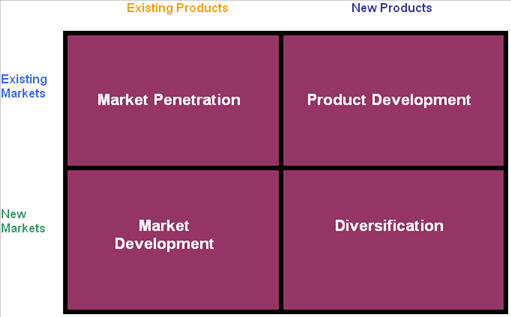
According to the model, you can adopt one of four strategies: market penetration, market development, product development or diversification. If, for example, you want new patrons to use your existing services, then a market development strategy is for you. As we talked about previously, sometimes it takes new products to lure in new patrons, and so a diversification objective would be appropriate. There's a nice tutorial and exercise with this model on marketingteacher.com that demonstrates how to put this tool to use.
From the library world, take a look at an article from a special librarian perspective by Grace McCarthy called, Getting to Know Your Non-Users. McCarthy offers tips for figuring out why patrons aren't using your library and the advantages and disadvantages of seeking their patronage. Interestingly, she also addresses the importance of managing patrons' expectations which, if unrealistic, can lead to non-use.
Librarians face an important and somewhat unique challenge when it comes to reaching out to potential patrons. In the business world, many marketers may say that not everyone will like your product or service, so it's best to forget about those people and focus on the ones who are most likely to buy what your selling. There's some truth to this. We can't expect that everyone in our communities will make use of our resources. But unlike business-types, we are charged with the sometimes daunting though ultimately rewarding task of making our holdings come alive for every person even if we're not always successful. Sure, we have to manage our resources responsibly and be fairly realistic in our aims, but ultimately we need to keep the big picture of intellectual freedom in sight. This worthwhile challenge presents an opportunity to apply a great deal of creativity and energy in taking the "non" out of "non-user."
Good luck! And, as always, feel free to share your thoughts and experiences!
Categories: tips_to_try | usable_theories
Friday, August 04, 2006
A healthy supplement to your marketing diet
I've been meaning to mention this blog for a while, since assessment goes with marketing like peanut butter goes with jelly - Yum!: Consider adding libraryassessment to your blog reading routine. The contributors are top-notch assessment librarians who share their expertise in academic library service assessment, evaluation and improvement. Here's a bit about the blog: "The definition of academic library assessment used here is very broad. We'’re interested in discussions about any activities that seek to measure the library'’s impact on teaching, learning and research as well as initiatives that seek to identify user needs or gauge user perceptions or satisfaction with the overall goal being the data-based and user-centered continuous improvement of our collections and services." It appears to be fairly new, but very promising, and I'm sure non-academic librarians will find it useful too.
Categories: train_yourself
Wednesday, August 02, 2006
Student workers as library ambassadors
My sincere thanks to Lynn Baird of the University of Idaho Library for sharing with me a great article she wrote entitled, Students as Storytellers: Advocacy from the Ranks (PDF). Lynn asserts that with proper training, student workers can be powerful Word-of-Mouth agents among fellow students. These ambassadors can help their peers overcome anxiety and feel more comfortable using the library as well as communicate the value of the library's services.
This idea is very worthwhile because everyone in an organization is a de facto ambassador, so it's important to give people the tools and training to be effective in that role. I believe I mentioned before that our undergraduate advisory committee began spreading the word about the library on their own initiative. They handed out event flyers to their friends and wanted to be included in events such as our library tours. As a result of their interest, service is now a requirement of committee members. Lynn's article reminds me that I need to incorporate training for these students so they are well-equipped to talk about the library with their peers and others in the campus community.
Though not directly related to word-of-mouth but relevant to this topic, I came across this helpful toolkit from ACRL called The Power of Personal Persuasion. I quickly discovered that librarianship involves a great deal of personal sales, and, if you're like me, this isn't a skill that comes naturally. This toolkit is intended to help front-line librarians advance the library's mission, and contains examples of persuasive arguments.
Categories: must_reads | promising_promotions | tips_to_try
Tuesday, August 01, 2006
Promoting events the RSVP way
Monday, July 31, 2006
Taking the "non" out of "non-user": Part 3 of 4
You know what your problems are and what you want to achieve, but now you have to actually bring your non-users into the fold. What do you do?
Welcome to Part 3: Possible tactics
The AMA defines tactics as "short-term actions undertaken to achieve implementation of a broader strategy." The assumption made is that you have a strategy in place before you start thinking about tactics (see Parts 1 and 2). The following tactics may or may not fit your strategy, so take them as starting-off points rather than prescriptions. Also, please do share tactics or strategies that have worked for you!
- Bring a friend: I'm a fan of the idea that our current patrons could be terrific partners in reaching out to new patrons, particularly since there is so much distrust of traditional forms of promotion. One way to do this would be to sponsor a "Bring a Friend" event, where current patrons bring friends and family who have never been to the library, have them sign them up for a library card, and enter a raffle. You could even feature your more enthusiastic borrowers by asking them talk to the newcomers about what the library means to them.
- Win over key leaders: Every community has key leaders and influential people who may prove to be effective in getting non-users inside your doors. Are there any civic, business or social groups in your community that could benefit from what your library can offer? Contact the leaders of these organizations for a brief meeting or presentation in which you outline specifically how the library can be an asset to members. Perhaps offer to lead an on-site workshop on a topic of interest to members. To be convincing, you may have to change/redesign/repackage your services to fit the needs of these targeted groups. For example, last month the Associated Press reported that libraries in New York and Pennsylvania are reaching out to small business owners through customized online resource aimed at helping them to write business plans and do market research. Tailoring your services leads to the next tip...
- Differentiate yourself: It's likely that one reason your non-users haven't made the leap to users is that they probably don't understand why your library's services are different or more useful than other sources of information they regularly use. When you reach out to these community members through e-mail or print mailings, events, etc., be sure to let them know what it is you can do for them that no one else can. Marketers call this your Unique Selling Proposition, and if you have one, flaunt it whenever possible. However, positive selling points will vary between target markets, so it's useful to fit your USP to each segment.
- Let people talk back: Perhaps your non-users have all kinds of good reasons for not visiting your library, but how will you know what they are (and how to address them) on an ongoing basis unless you give people opportunities to share their thoughts with you? As you go out into the community, make it a point to ask people what you could do differently or better, or for any "Wouldn't it be cool if...?" ideas they may have. Include suggestion cards with mailings or when doing outreach events, and make sure that your Web site clearly shows how patrons can contact staff with questions or concerns.
Update: Steve Backs of Blog about Libraries has some great points about differentiation that are worth taking a look at.
Categories: tips_to_try
Thursday, July 27, 2006
What your clothes say about you (and your library)
Thanks to Sophie over at Pop Goes the Library for a great word-of-mouth/general promotion idea: customized hoodie sweatshirts. Check out her post to find out how you can customize your clothing for library events or just to make people jealous of your keen fashion sense. :)
Categories: promising_promotions
Word-of-mouth tips from the PIO
ALA's Public Information Office (PIO) has made materials available from its most recent PR Forum, Word of Mouth Marketing @ your library. You'll find handouts, a presentation outline, and Naperville Public Library's communication policies and guidelines.
Categories: resource_roundup | train_yourself
Wednesday, July 26, 2006
Keeping bad things out of the way of good causes
Today's resource comes by way of a university colleague who works in the area of health promotion. She recommends the site agoodmanonline.com for finding promotion/advertising guidance for public interest groups and other non-profits. The site's owner, Andy Goodman, is a communications consultant who "specializes in helping public interest groups, foundations, and progressive businesses communicate more effectively through print, broadcast media, and the Internet." If you click on the Publications link, you'll find some great, free publications, including the one recommended to me, Why Bad Ads Happen to Good Causes.
Hope it's helpful!
Categories: must_reads | promising_promotions | resource_roundup
Monday, July 24, 2006
A tactical tip on reverse testimonials
This tactical tip comes by way of John Jantsch of the Duct Tape Marketing Blog. If you already collect patron testimonials, John suggests a way to get more mileage from them: create a 10-12 postcards with the client's (patron's) testimonial, an offer and your contact information, and direct the client to jot a handwritten note on the postcards to send to people who could use the information. This can be done cheaply in-house and sounds like a good way to get patrons sharing their terrific library experiences with one another!
Speaking of tips, the AcademicPR listserv began a Forum where librarians can share their ideas without the flood of e-mail messages that ensues. The most recent topic of discussion is library giveaways.
Categories: tips_to_try | promising_promotions
Friday, July 21, 2006
Taking the "non" out of "non-user": Part 2 of 4
Once you have a good idea of what's keeping potential patrons from becoming actual patrons, you'll also want to come up with some objectives for your marketing initiative, which brings us to:
Part 2: What are you trying to do? (Setting goals)
You may be thinking that the goal here is obvious - you want non-users to become users. Doing so, however, is not as straightforward as it may seem. What, for example, defines use and non-use? Patrons may be users in some respects, but non-users in others. Perhaps you have teens who are heavy users of your library's computing resources, but they don't take advantage of your homework help service or your electronic databases. Also, what about patrons who simply don't have any relationship whatsoever with your library? Do you want to get them through your doors for programs and events? Or encourage them to sign up for library cards? Or prompt them to utilize your online resources? All of the above? If you don't know who you want to do what you'll have a hard time persuading anyone to do anything. Your marketing efforts will come across as jumbled and irrelevant, and you'll waste a lot of time and money in carrying them out.
For these reasons, you'll want to choose a population (target market) and an objective(s) related to that population's needs. Hopefully, the direction you take became apparent as you identified the problem. During your initial investigation, you could find, for instance, that a substantial group of your non-users (however you've defined it) happen to be working mothers who would like more children's programming at convenient hours. Now you know "who" (a market segment of working mothers in a particular geographic area with children of a certain age...) and "what" (children's programming that takes place during hours that are convenient for working mothers). At this point you can customize your marketing strategy to address the needs of this group and create promotions that ask people to take a specific action (attend the programs). Also, it's usually best to set some kind of numerical and/or measurable goal. In this example, you could set goals for the number of attendees or levels of satisfaction with the programming.
What's difficult about this is that hard choices have to be made. We want to reach out to everybody, but it's virtually impossible to appeal to all non-users in the same way because they all have different needs and characteristics. (If you can do this, by the way, you have a very lucrative career waiting for you in marketing!) Ultimately, you have to select and target the groups you can serve most effectively. Remember too that marketing plans don't last forever. You can target one group for the next six months to one year and then adopt a new strategy. You can also implement more than one strategy at a time. The idea here is to have a crystal clear plan of what you want to accomplish, focus your efforts on that target group and desired outcome, and assess if you met your goals.
Stay tuned for Part 3: Possible tactics.
Categories: tips_to_try
Wednesday, July 19, 2006
Taking the "non" out of "non-user": Part 1 of 4
Attracting those who don't yet use library services is an ongoing challenge for all libraries. In fact, I suspect most of your marketing efforts include, to varying degrees, reaching out to non-users. As I mentioned back in May, I'd like to give this topic focused attention. While the overall marketing considerations don't vary drastically from marketing aimed at current users, there are enough differences to warrant special consideration. In addition to the points I mention, I'm always very interested to know what your experiences have been, since we all have unique situations and user populations that can lend some insight into this issue. [Note: This series isn't intended to be a step-by-step program, but rather a collection of factors to take into account when marketing to non-users.]
Without further ado, let's get on with Part 1: Figuring out the problem:
There may be lots of reasons why people don't use your library, and they may not be what you assume. Maybe they just don't like libraries in general. Or, maybe they love libraries but are pressed for time, can't accommodate the hours you're open, or regularly can't find what they need at your library. Perhaps they had some very bad service experiences or don't care for your particular library environment (too loud, too quiet). The answer can be any one of a number of things, but the first step in reaching your non-users is figuring out what exactly is getting in the way of them becoming regular library patrons. As you can see, the problems you identify will make a considerable difference in your marketing planning. If, for example, the problem is poor customer service, you'll want to concentrate on service training and communications that promote your new and improved service (once it actually is new and improved, of course)! If, on the other hand, your non-users just don't like libraries in general, maybe you need a promotion campaign focused on repositioning and creating awareness of the benefits that modern libraries have to offer.
How can you go about identifying the problem? You may already have a strong sense of what's holding people back based on your personal experience, but you should probably consider doing some exploratory research to test your impressions. Perhaps conducting some focus groups will give you a rough idea about what the major issues are. Also, take advantage of opportunities that present themselves to talk with people in the community about their library use. Then, if needed, you can design and conduct a community-wide survey that assesses the problematic areas to determine which ones are the most pressing.
This important step may seem simple, but it's not! Getting at the underlying root causes of non-use requires more than just guesswork. It requires some focused inquiry and research. Getting it right can make the difference between a marketing success and a marketing flop.
Next: Part 2: What are you trying to do? (Setting goals).
Categories: tips_to_try
Tuesday, July 18, 2006
Coming to a theater near you...book trailers!
NPR's John Ydsti reports today on one of book publishers' novel marketing ploys: book trailers. Just like movie trailers, book trailers give audiences glimpses into what's going on between the covers of the latest titles. Some of these trailers are selectively aired in theaters near bookstores to prompt those post-movie purchases, while others are Web-only productions. For a discussion of this tactic, see the CBC's piece from earlier this month, "View to a Thrill."
Categories: new_news | promising_promotions
Thursday, July 13, 2006
Enlivening e-mail
For many of us, e-mail is an important promotional tool, but are we using it to its fullest potential? A marketing research report featured on KnowThis.com suggests that e-mail subject lines that are very specific have the best chances of increasing conversion rates (or, in our case, getting patrons to read the e-mails and/or take an action). The report comes from MarketingExperiments.com where you can find numerous reports on e-mail marketing, including one about launching effective e-mail campaigns that reveals ten key points for getting the most out of e-mail.
As I was looking around on MarketingProfs.com, I also found a terrific article, Putting Personality into your E-newsletter. Yes! Thank you, MarketingProfs! (Free registration required). I like this article because it recognizes the distinction between adding a touch of human authenticity and going overboard with getting way too personal, and instructs people on how to find the right balance.
Update: The 7/17/06 edition of the Wall Street Journal has an article called, "Marketers Give Email Another Look" that describes research done regarding which parts of an e-mail message get the most attention. The research found that graphical icons and terms like "solutions" raised some eyebrows, but that the word "free" got little notice.
Categories: research_and_reports | tips_to_try
Wednesday, July 12, 2006
Fantastic failures
One thing I've learned since beginning my professional career as a librarian is that it is much, much worse to favor the status quo than to embrace risk (and the unavoidable "failures" that experimenting brings). To point out the obvious, the pace of change only gets faster. To keep up, we need to be creative and daring in how we tackle the future. That's why I'm pleased to see that creativity is getting its due in marketing/business and education circles.
Take two recent articles from BusinessWeek online: How Failure Breeds Success and Inside Google's New-Product Process. The former details how businesses are trying to reshape their workplaces into creativity labs that embrace the speed bumps (or potholes) on the road to breakthroughs. These companies are even highlighting failures in their presentations and workshops so to deconstruct the creative process and figure out why some things didn't work. The article's author states, " "Getting good" at failure, however, doesn't mean creating anarchy out of organization. It means leaders -- not just on a podium at the annual meeting, but in the trenches, every day -- who create an environment safe for taking risks and who share stories of their own mistakes. It means bringing in outsiders unattached to a project's past. It means carving out time to reflect on failure, not just success." The author also points out that there's a difference between pointless failures and intelligent ones. Intelligent failures allow employees to see their customers and their problems in a new light. These moments of insight could be the early stages of later successes.
Google seems to get this concept and welcomes the failures that come along with successes, as discussed in the other article. Google's vice-president of search products and user experience, Marissa Mayer, talked about the company's perspective and said, "The way you find really successful new innovation is to release five things and hope that one or two of them really take off." She also describes Google's product design philosophy where teams work together to "build a vision" around the product while leaving plenty of room for changes and flexibility so that creativity is not driven out of the process.
Related to the value of failures, Harvard Business School's Working Knowledge interviewed authors of a working paper entitled, "Accident, Innovation, and Expectation in Innovation Process," written by Robert D. Austin and Lee Devin. The authors identify numerous innovations that happened by accident including anesthesia, Ivory soap, nylon, penicillin and photography, and point out that many such discoveries happen when people are tuned in to noticing the value of accidents as a way to envision other possibilities. They also point out that fixating too much on a particular end result when one is trying to anticipate unknowns can backfire by shutting out creativity.
Business-types are not the only ones honing in on the practical importance of creativity. Steven Bell reported that Tufts University is rethinking its admissions strategy, giving weight to students' creative prowess in addition to their test scores and GPA's. Today, Bell also shared a presentation by author Sir Ken Robinson in which he argues that education stifles creativity.
Why do I continue to talk about creativity and risk-taking on a library marketing blog? I do so because marketing is all about anticipating the unknown. We conduct surveys, analyze trends and statistics, organize focus groups and all kinds of other things with the purpose of figuring out (guessing) what people need and imagining ways to fill those needs. Doing this takes a leap of faith. We have to believe our information is accurate, that we're interpreting it correctly and that the services we come up with are useful and needed. When we're talking about something as amorphous as needs and wants, it's impossible to be 100% right 100% of the time. The only thing we can do in marketing 100% of the time is innovate and learn. A lot of times, I hear people say that library work isn't life-or-death work. Why, then, should librarians behave as if their actions (or failures) carry that kind of weight? I don't want to demean the importance of what we do or the decisions we make. Librarians do some of the most culturally and socially important work there is, which is why I chose to become one. But, relatively speaking, the impact of possible failures from smart experimentation are relatively small as compared with the truly risky prospect of doing nothing at all.
Catgories: creativity_and_inspiration | must_reads | real_life
Monday, July 10, 2006
Marketing trends are catching on
Today's Wall Street Journal gives special attention to how businesses are trying to attract attention, in its special reports on marketing! Two articles of particular interest to library-land inhabitants are The Marketing Maze and, from the Advertising section, Dell Skips Tech Talk for a More-Personal Link (yep, a subscription is required to read these). The former reports on the various communication channels marketers are exploring to snag a piece consumers' increasingly divided attention. Marketers seek to fuse themselves into life events, as one marketer put it, rather than relying on the more traditional approaches they've used in the past. The messages are becoming increasingly more targeted, and so are the marketing channels. Exciting times for sure!
The second article is an especially important one for service providers. The article sketches out the new marketing initiatives Dell is undertaking to portray its products as more than just an assembly of technology components. Instead, the company wants to highlight the emotional aspects of computing, such as sharing photos and making videos, employing the tagline, "Purely You" to capture this focus on personalization. A brand consultant remarks that this is a good move because competing on product features alone isn't enough since other companies can easily duplicate those advantages. In library services where so much of what we do is intangible, good marketing relies in part on an understanding and appreciation of patrons' emotional connections with the library.
You can also listen to a WSJ podcast about how marketers are trying to sort out the effectiveness of their advertising campaigns in this new marketing environment.
Categories: must_reads | neat_trends
Thursday, July 06, 2006
Perfecting PR
KnowThis.com released yet another module of its Principles of Marketing Tutorial: Public Relations. As with the other modules, this one is excellent for getting a grasp of the basics. The tutorial covers topics like what PR is, its advantages and disadvantages, PR tools and trends (including blogs and podcasts!).
Categories: train_yourself
Wednesday, July 05, 2006
Beyond "outside the box": Three new books on marketing and creativity
Welcome back! I hope you all had a great Fourth of July holiday!
To get you back in a marketing mindset, the New York Times reviews three new books on the topic of sparking creativity in the business/marketing world: Juicing the Orange, How Invention Begins and Funny Business. Of these, Juicing the Orange appears to have the best reviews and seems to be more focused on marketing in a broad sense. The authors lay out a seven-step creativity plan, including some downright intriguing steps like, "always start from scratch" (don't we usually try to avoid doing this?) and "find a 'proprietary emotion' you can appeal to". I'm excited to read it once I widdle down my reading pile a bit. If you get to reading it before I do, please feel free to leave your take on it in the comments!
Update: BusinessWeek online has another review of Juicing the Orange.
Categories: must_reads


 Libraries are more than just collections of books and other materials. Libraries are dynamic forces in their communities with the power to improve lives. Modern marketing demands that librarians look beyond their traditional roles ("outside the book") to find new ways to connect with people and further their success.


