Check out Steven Cohen's report of ASU Libraries' marketing efforts to kick off the new academic year! The intrepid librarians at ASU set up an information tent where they provided directional assistance and water for thirsty students. (By the way, campus event organizers tell me that water is a very popular give-away item. It seems to have worked for ASU-they gave out over 2,100 bottles in 2 days!). You can catch the action on Flicker. ASU Libraries also released its selection of podcasts.
Update: I noticed that one of the podcasts offered is a 3-part series entitled, Matching Innovations to Environment by Joan Frye Williams. The description states, "Joan explains how librarians can improve their chances of success by implementing the innovations that best match their particular type of library environment. She demonstrates [sic] and why innovation is seldom easy, and even best practices aren’t "one size fits all."' I'm looking forward to listening to these because I believe that good marketing planning considers trends and new technologies in the context of an organization's goals, strengths and weaknesses. New isn't always better when it doesn't serve the target market and the organization.
Categories: new_news | real_life
Tuesday, August 29, 2006
Marketing frenzy at ASU

Monday, August 28, 2006
Marketing goes mobile
Marketers don't waste much time in figuring out how to utilize new technologies to promote their wares to consumers. The International Herald Tribune has a terrific article that summarizes the headway advertisers are making into the world of mobile communications. The article states that, worldwide, there are twice as many cell phones as PC's, and that opt-in, SMS-based campaigns have met some success among niche markets in Europe.
Should libraries be thinking about delivering their services via mobile devices? You betchya! In fact, some librarians are already dipping their toes into these promising waters.
Oh, and in case you were wondering, there is of course a marketing organization focused on this emerging aspect of marketing - the Mobile Marketing Association. I was pleased to find that the MMA site offers a fairly rich set of information and resources for non-members, including articles and statistics.
Categories: neat_trends | new_news | promising_promotions | technology_tools
More on the 2007 ACRL Best Practices in Marketing Academic and Research Libraries @your library Award
My thanks to Mark Sanders, Reference Librarian and Outreach Coordinator at Joyner Library at East Carolina University for sharing more details about the 2007 ACRL Best Practices in Marketing Academic and Research Libraries @your library Award. Mark would like to encourage quality applicants to apply, and I'm happy to continue to help get the word out about this great opportunity for you cutting-edge librarian-marketers out there. Here, Mark shares some more details about the award:
"ACRL, through funds provided by Springer, will once again award academic libraries that have demonstrated an outstanding best practices marketing program. The three award categories include community college, college, and university. Each winning library will receive a plaque and $2,000 award to be presented at the 13th ACRL National Conference in Baltimore, Maryland, March 29 - April 1, 2007.
In 2005, a $2,000 award was presented to American University for first place, and a $1,000 award was presented to Illinois State University for second place. The American University Library marketing plan was carried out through an intelligent, focused, and creative marketing plan, as well as exemplary use of partnerships with campus units and tools developed by professional organizations, including the ACRL Toolkit for Academic and Research Libraries. Illinois State University made use of a good survey instrument to identify marketing challenges, coupled with a combination of good planning and broad-based involvement, and the graceful application of "“@ your library" themes. Both institutions demonstrated strategies and practices that can be adapted at other academic libraries to effectively market their resources and services to the campus community.
More information about the 2007 award criteria, portfolio submission instructions, and past award winners' marketing plans and supplemental materials can be found at http://www.ala.org/ala/acrl/acrlissues/marketingyourlib/marketingyour.htm."
Thanks, Mark, and best of luck to those of you who apply!
Categories: new_news | real_life
Thursday, August 24, 2006
Scripts 'n' such
Most service interactions involve some kind of script. And I'm not talking about the written down kind that actors and telemarketers use. I'm talking about the ideas we all have about how a service experience should go. For example, when I go into a clothing store, I expect someone to greet me, ask me how I'm doing and if there's anything they can help me with. When I'm ready to pay for my items, I wander over to the sales counter where the salesperson will usually say something to the effect of "Did you find everything you were looking for?" and I'll tell them yes or no. They'll ring up my order, I'll give them some form of payment, and they'll probably inform me of a promotion or credit card offer, bag my things, and I'm on my merry way. The script doesn't always unfold exactly like this, but it's a pretty good estimation of a retail shopping experience.
But lately I've noticed that salespeople can really mess up this script. Sometimes the changes are good, but other times they're very unwelcome! The two most notable examples from my recent experiences happen to come from two different fast food restaurants. At one Wendy's I frequent, I've noticed that they seem to have no regard for scripts lately. I place my order, pay for it, get my food and...that's it. No "thank you" or "have a nice day" or anything to indicate that the transaction is complete. This has happened a couple of times in a row now and it always leaves me feel like something is missing or not quite right (probably the lack of manners). This is a complete contrast to what goes on at a neighboring Chick-Fil-A. Every employee answers my requests with the phrase, "my pleasure." Example:
Me: "Can I have some extra sauce with that?"
Nice Chick-Fil-A Employee: "Sure!"
Me: "Thank you!"
Nice Chick-Fil-A Employee: "My pleasure!"
I love this! In fact, this small gesture is one of the ways in which Chick-Fil-A's service stands out from all the rest and it's one of the first things that comes to my mind when I think about eating there. To top it off, the employees seem to mean it and don't display a bit of sarcasm. Furthermore, almost every employee says it every time. That one aspect of service delivery says a LOT to me about the company and its regard for its customers. The very polite employees so impressed me that I made it a point to tell the manager about how impressed I am.
Scripts aren't necessarily spoken dialogue, but service providers should be aware of what people's service expectations are and how they can meet and shape them. Chick-Fil-A management probably thought that customers will expect employees to respond to "thank you's" with "you're welcome's." They decided to pleasantly upset the status quo by inserting "my pleasure's." The result is a script that reinforces the brand image and improves customer satisfaction (well, at least mine!). The only possible downside here is that now I expect the revised script and if I don't get it, I'm bound to feel a bit let down. The Wendy's in question, however, trashed the script and left customers (ok, this customer) feeling unsatisfied and awkward. In the library setting, patrons have all sorts of scripts for how using the library should work. We can pleasantly surprise them by inserting some unexpected elements into those scripts, or we can disappoint them by not fulfilling expectations. I try to do the former in small ways such as following up on research consultations. Patrons may expect that they come in, get research help, leave, and that's the end of it. But by following up, I add a new element into the script that hopefully improves their views of library services.
Does anyone have an example of a company that altered a script for the better? Let me know!
Update: While not about scripts exactly, Seth's Blog has a nice post on customers' expectations and what you can do about them (embrace them, change them, or defy them).
Categories: usable_theories
Wednesday, August 23, 2006
Explaining the complex with simple copy
MarketingProfs.com has an interesting article called Six Ways to Turn Techno-babble Into Commanding Copy. While the article is concerned with how to write clear, convincing copy about technical devices, these tips are certainly applicable to our library services and offerings. Specifically, the author points out how to describe the benefits of a product or service in a way that is understandable to non-experts. I particularly like the tips about "painting a picture of the opportunity" and "show it [the product or service] in action." Complex services require promotions that speak to the patron on an emotional as well as intellectual level within the context of familiar experiences, as the author describes.
This point leads me to a thought I have been considering for quite some time: Technology offers incredible breakthrough opportunities for the design, delivery, promotion and overall marketing of library services. However, that same technology can make those services more abstract and unfamiliar to patrons. A blog, for example, is really just a journal, but the addition of the technology and specialized terminology transform that journal into something further removed from people's frame of reference, which can be off-putting. The mingling of technology with library services and marketing is nothing new, but the more technology based our services become, the more important the human aspects of marketing become. To be effective in a techie world, marketers have to reach ever more specific audiences with customized messages, services and delivery systems; they must communicate clearly with patrons in cluttered virtual and physical environments; they need to become educators regarding the technologies they use or make available. Doing all of these things relies on more than just marketing know-how - it relies on a fundamental understanding of people, their motivations, perspectives and needs. I think this is why I enjoy studying Marketing so much, in the same way I enjoyed studying History as an undergraduate. Both disciplines concern people and their behavior, and an understanding of people is what librarian-marketers will need to make technological services meaningful and understandable to patrons.
Categories: must_reads | usable_theories
Tuesday, August 22, 2006
Concerning creativity
Does this sound familiar?: You turn on the T.V., computer, or flip open a magazine to find a stunning, creative, attention-getting ad only to find that, moments later, you've forgotten what was being advertised (if you were able to figure it out in the first place!). Can creativity be more foe than friend to your marketing efforts if left unchecked?
Creativity is one of the most important skills librarians can bring to bear on their marketing efforts. However, I often wonder if too much creativity (if there is such a thing) applied to promotions can actually do more harm than good by stealing the show from the core marketing messages. In participating in outreach events, I question whether any student is able to come away with a coherent message given all the "noise" of give-aways, games, and decorations. Here's a working list of points I consider when balancing creativity with promotion objectives:
- Do the creative elements reinforce the message or compete with it? Outrageous games, stunts and gimmicks can nab patrons' attention, but once you have their attention, what are you going to do with it? Try to make the most of the rare instances when you have someone's undivided attention by communicating your message and listening to patrons' points of view. If the creative elements don't allow that to happen, they may need to be scaled back a bit. Also, do those attention-getters conflict with the messages you want to communicate? It's helpful to step back from creative ideas to determine how well they mesh with promotion goals.
- How can creative ideas make lasting value for patrons? I like for my creative promotion tactics to have some staying power and be useful to patrons. This summer, for example, I raffled off USB flash drives to students who signed up for our listserv. Students get a prize they can use as they do research and write papers, and they also receive relevant library news well into the future. In an academic setting, I prefer edu-taining events, prizes, etc. that are fun and attention-getting, but that also expose students to aspects of library services.
- What's the context? In a stroke of luck this summer, I gave away mint Lifesavers at my display table. I didn't know it beforehand, but at this event parents of incoming students were given free cups of coffee, so the mints were a big hit! This happy coincidence reminded me of the importance of knowing as much as possible about the context in which the promotion will take place.
Categories: real_life | tips_to_try
Monday, August 21, 2006
Sweetening your brand with M&M's
According to news sources, Masterfoods USA will be allowing companies to feature logos or messages on M&M candies. Currently, customers can add their own messages to the candies, but this new service will allow businesses stick their logos on these bite-size treats.
I deemed this newsworthy for two reasons: 1. This service may be attractive to libraries looking for new and different promotion vehicles, although, it'll cost you (there will be a $100 set-up fee and $30 per pound charge for the customized candies). 2. This is yet another example of how customers seek ever-higher degrees of customization and how companies, like Masterfoods USA, are opening up their brands to allow for greater interactions with customers. We are seeing this trend spill over into the library world in our services and products in the form of customizable RSS feeds, alerts, and interfaces to name a few.
If anyone has had experiences with customizing M&M's for library promotion purposes, or has thoughts on this trend toward customization, please feel free to share them here!
Categories: new_news | promising_promotions
Friday, August 18, 2006
Are you sold on personal sales?
I've been on vacation this week, which is why posts here have been few and far between, but I have a lot of pent-up marketing thoughts to share next week so I hope to have more content soon.
In the meantime, I encourage you to check out the latest addition to the KnowThis.com Principles of Marketing Tutorial, Personal Selling. This module covers advantages and disadvantages of personal sales as well as trends in the field.
Personal sales in the library setting is a particular interest of mine, because I often find myself taking on a sales-like role in meetings, at fairs and in classes and presentations. I'm often tailoring persuasive messages to fit the needs of my audiences and convincing them that the library and its resources can be great assets to the specific work they're doing. In fact, the ability to customize messages to the individual patron is one big advantage of personal sales. Here are some situations in which personal sales techniques are appropriate:
- Unsought products/services: Library services may be unsought because they're new or just not well-known or widely used. Personal sales is a great way to get the word out about these resources.
- Complicated products/services: Personal sales may be a necessary part of the promotion mix when what you're selling is difficult for patrons to understand. Consider our databases. I doubt it's very clear to most patrons what they are, what they can do, and what benefits they offer. Personal selling gives librarians an opportunity to communicate large amounts of information in a way that makes sense to the individual patron.
- Building relationships: If you want to build and maintain relationships with patrons, nothing beats a bit of face time.
- High-risk products/services: This situation my not apply to many library services since our offerings tend to carry no or little direct cost to patrons, but some patrons may harbor anxiety when it comes to asking for help, for example. Personal sales can help to alleviate those fears and persuade patrons to consult with library staff for their information needs.
Categories: tips_to_try | train_yourself
Monday, August 14, 2006
Aggregator additions
Two new-to-me marketing blogs caught my eye in recent days and you may also find them worthy of your aggregator:
Emergence Marketing is written by the president of Corante, Inc. and a marketer who specializes in marketing information technology products. As the authors assert, the blog is about, "Thoughts on marketing, innovation, social networking, new products and the impact of technology on all those thingies." There's fascinating stuff here, and I'm particularly excited about the technology slant on marketing that the blog offers (more on technology and marketing libraries to come!).
The second blog called The Brand Builder Blog was recently named one of the Top 11 Word of Mouth Blogs (as was Emergence Marketing). While the blog appears to be lacking much detail about the authors, the posts are solid (and the cute chihuahua doesn't hurt either! ;-) ).
Categories: resource_roundup
5th IFLA International Marketing Award
Thanks to Dinesh Gupta for informing me of the 5th IFLA International Marketing Award. The purpose of the Award is to recognize the best library marketing project each year. The deadline for applications is November 30, 2006.
In other IFLA news, Dinesh is also organizing a poster session for the IFLA Seoul Conference scheduled for August 22-23. According to Dinesh, the poster entitled, In Search of Marketing Excellence, "is to bring out visibility of the "IFLA INTERNATIONAL MARKETING AWARD". The poster provides a review of the past winners, their impressions. It will also project the Award amongst the IFLA community to attract more qualitative applications for the year 2007. Besides perspective applicants, we are expecting visits of Jury Members, Award Winners, Marketing Advocators, Educators, and others who have interest in marketing LIS.
Through the blog, we invite all interested persons in Management and Marketing to the IFLA Poster Session."
Categories: new_news | real_life
Tuesday, August 08, 2006
What's working: Top marketing trends
Mobile marketing, RSS, MySpace, WOM, and out-of-the-ordinary promotion vehicles are just some of the marketing trends shaping marketing today, according to Entreprenuer.com. In one neat example of text messaging in action, the article mentions how some restaurants text the daily specials to their customers. Hmm...couldn't we do the same with new titles, services and events?
The danger here is that, while many of these promotion venues look promising today, tomorrow they may be seen as just another form of clutter. For these reasons, it's important, and just downright responsible, to make sure that the messages we put out there are targeted and relevant to the target market.
Categories: neat_trends | promising_promotions
Monday, August 07, 2006
Taking the "non" out of "non-user": Part 4 of 4
Thanks for sticking with me through Part 4 of 4 of this series of posts: Additional Considerations & Final Thoughts! Here, I list an assortment of odds and ends for your consideration.
By now it has probably become apparent that bringing potential patrons into the fold means relinquishing the status quo. Whether you're changing your objectives, your services, your tactics or your target market, the bottom line is that you have to change something to draw in users or else they'd already be regular patrons! Doing so takes an institutional commitment to change and may also require major overhauls of services or facilities as well as additional funds. In fact, a key to turning non-users into users is a future-oriented, progressive approach to planning. We should always keep an eye on trends and events that offer opportunities to reach out to new users, or to reach out to current users in new ways. Changes in technology, the economy, and social life are just some of the factors that can create new and exciting venues for library services.
The pursuit of new customers is a familiar aim of both librarians and marketers, and as such, both the library and business literature offer some guidance on this topic:
The Ansoff Matrix has been a popular tool among business-types in helping them to make decisions about their growth objectives. Turns out, there's more than one way to grow a business (or a library, for that matter). Here's the Matrix as drawn by yours truly: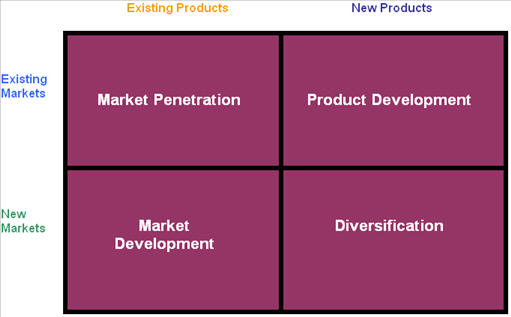
According to the model, you can adopt one of four strategies: market penetration, market development, product development or diversification. If, for example, you want new patrons to use your existing services, then a market development strategy is for you. As we talked about previously, sometimes it takes new products to lure in new patrons, and so a diversification objective would be appropriate. There's a nice tutorial and exercise with this model on marketingteacher.com that demonstrates how to put this tool to use.
From the library world, take a look at an article from a special librarian perspective by Grace McCarthy called, Getting to Know Your Non-Users. McCarthy offers tips for figuring out why patrons aren't using your library and the advantages and disadvantages of seeking their patronage. Interestingly, she also addresses the importance of managing patrons' expectations which, if unrealistic, can lead to non-use.
Librarians face an important and somewhat unique challenge when it comes to reaching out to potential patrons. In the business world, many marketers may say that not everyone will like your product or service, so it's best to forget about those people and focus on the ones who are most likely to buy what your selling. There's some truth to this. We can't expect that everyone in our communities will make use of our resources. But unlike business-types, we are charged with the sometimes daunting though ultimately rewarding task of making our holdings come alive for every person even if we're not always successful. Sure, we have to manage our resources responsibly and be fairly realistic in our aims, but ultimately we need to keep the big picture of intellectual freedom in sight. This worthwhile challenge presents an opportunity to apply a great deal of creativity and energy in taking the "non" out of "non-user."
Good luck! And, as always, feel free to share your thoughts and experiences!
Categories: tips_to_try | usable_theories
Friday, August 04, 2006
A healthy supplement to your marketing diet
I've been meaning to mention this blog for a while, since assessment goes with marketing like peanut butter goes with jelly - Yum!: Consider adding libraryassessment to your blog reading routine. The contributors are top-notch assessment librarians who share their expertise in academic library service assessment, evaluation and improvement. Here's a bit about the blog: "The definition of academic library assessment used here is very broad. We'’re interested in discussions about any activities that seek to measure the library'’s impact on teaching, learning and research as well as initiatives that seek to identify user needs or gauge user perceptions or satisfaction with the overall goal being the data-based and user-centered continuous improvement of our collections and services." It appears to be fairly new, but very promising, and I'm sure non-academic librarians will find it useful too.
Categories: train_yourself
Wednesday, August 02, 2006
Student workers as library ambassadors
My sincere thanks to Lynn Baird of the University of Idaho Library for sharing with me a great article she wrote entitled, Students as Storytellers: Advocacy from the Ranks (PDF). Lynn asserts that with proper training, student workers can be powerful Word-of-Mouth agents among fellow students. These ambassadors can help their peers overcome anxiety and feel more comfortable using the library as well as communicate the value of the library's services.
This idea is very worthwhile because everyone in an organization is a de facto ambassador, so it's important to give people the tools and training to be effective in that role. I believe I mentioned before that our undergraduate advisory committee began spreading the word about the library on their own initiative. They handed out event flyers to their friends and wanted to be included in events such as our library tours. As a result of their interest, service is now a requirement of committee members. Lynn's article reminds me that I need to incorporate training for these students so they are well-equipped to talk about the library with their peers and others in the campus community.
Though not directly related to word-of-mouth but relevant to this topic, I came across this helpful toolkit from ACRL called The Power of Personal Persuasion. I quickly discovered that librarianship involves a great deal of personal sales, and, if you're like me, this isn't a skill that comes naturally. This toolkit is intended to help front-line librarians advance the library's mission, and contains examples of persuasive arguments.
Categories: must_reads | promising_promotions | tips_to_try
Tuesday, August 01, 2006
Promoting events the RSVP way
Monday, July 31, 2006
Taking the "non" out of "non-user": Part 3 of 4
You know what your problems are and what you want to achieve, but now you have to actually bring your non-users into the fold. What do you do?
Welcome to Part 3: Possible tactics
The AMA defines tactics as "short-term actions undertaken to achieve implementation of a broader strategy." The assumption made is that you have a strategy in place before you start thinking about tactics (see Parts 1 and 2). The following tactics may or may not fit your strategy, so take them as starting-off points rather than prescriptions. Also, please do share tactics or strategies that have worked for you!
- Bring a friend: I'm a fan of the idea that our current patrons could be terrific partners in reaching out to new patrons, particularly since there is so much distrust of traditional forms of promotion. One way to do this would be to sponsor a "Bring a Friend" event, where current patrons bring friends and family who have never been to the library, have them sign them up for a library card, and enter a raffle. You could even feature your more enthusiastic borrowers by asking them talk to the newcomers about what the library means to them.
- Win over key leaders: Every community has key leaders and influential people who may prove to be effective in getting non-users inside your doors. Are there any civic, business or social groups in your community that could benefit from what your library can offer? Contact the leaders of these organizations for a brief meeting or presentation in which you outline specifically how the library can be an asset to members. Perhaps offer to lead an on-site workshop on a topic of interest to members. To be convincing, you may have to change/redesign/repackage your services to fit the needs of these targeted groups. For example, last month the Associated Press reported that libraries in New York and Pennsylvania are reaching out to small business owners through customized online resource aimed at helping them to write business plans and do market research. Tailoring your services leads to the next tip...
- Differentiate yourself: It's likely that one reason your non-users haven't made the leap to users is that they probably don't understand why your library's services are different or more useful than other sources of information they regularly use. When you reach out to these community members through e-mail or print mailings, events, etc., be sure to let them know what it is you can do for them that no one else can. Marketers call this your Unique Selling Proposition, and if you have one, flaunt it whenever possible. However, positive selling points will vary between target markets, so it's useful to fit your USP to each segment.
- Let people talk back: Perhaps your non-users have all kinds of good reasons for not visiting your library, but how will you know what they are (and how to address them) on an ongoing basis unless you give people opportunities to share their thoughts with you? As you go out into the community, make it a point to ask people what you could do differently or better, or for any "Wouldn't it be cool if...?" ideas they may have. Include suggestion cards with mailings or when doing outreach events, and make sure that your Web site clearly shows how patrons can contact staff with questions or concerns.
Update: Steve Backs of Blog about Libraries has some great points about differentiation that are worth taking a look at.
Categories: tips_to_try
Thursday, July 27, 2006
What your clothes say about you (and your library)
Thanks to Sophie over at Pop Goes the Library for a great word-of-mouth/general promotion idea: customized hoodie sweatshirts. Check out her post to find out how you can customize your clothing for library events or just to make people jealous of your keen fashion sense. :)
Categories: promising_promotions
Word-of-mouth tips from the PIO
ALA's Public Information Office (PIO) has made materials available from its most recent PR Forum, Word of Mouth Marketing @ your library. You'll find handouts, a presentation outline, and Naperville Public Library's communication policies and guidelines.
Categories: resource_roundup | train_yourself
Wednesday, July 26, 2006
Keeping bad things out of the way of good causes
Today's resource comes by way of a university colleague who works in the area of health promotion. She recommends the site agoodmanonline.com for finding promotion/advertising guidance for public interest groups and other non-profits. The site's owner, Andy Goodman, is a communications consultant who "specializes in helping public interest groups, foundations, and progressive businesses communicate more effectively through print, broadcast media, and the Internet." If you click on the Publications link, you'll find some great, free publications, including the one recommended to me, Why Bad Ads Happen to Good Causes.
Hope it's helpful!
Categories: must_reads | promising_promotions | resource_roundup
Monday, July 24, 2006
A tactical tip on reverse testimonials
This tactical tip comes by way of John Jantsch of the Duct Tape Marketing Blog. If you already collect patron testimonials, John suggests a way to get more mileage from them: create a 10-12 postcards with the client's (patron's) testimonial, an offer and your contact information, and direct the client to jot a handwritten note on the postcards to send to people who could use the information. This can be done cheaply in-house and sounds like a good way to get patrons sharing their terrific library experiences with one another!
Speaking of tips, the AcademicPR listserv began a Forum where librarians can share their ideas without the flood of e-mail messages that ensues. The most recent topic of discussion is library giveaways.
Categories: tips_to_try | promising_promotions
Friday, July 21, 2006
Taking the "non" out of "non-user": Part 2 of 4
Once you have a good idea of what's keeping potential patrons from becoming actual patrons, you'll also want to come up with some objectives for your marketing initiative, which brings us to:
Part 2: What are you trying to do? (Setting goals)
You may be thinking that the goal here is obvious - you want non-users to become users. Doing so, however, is not as straightforward as it may seem. What, for example, defines use and non-use? Patrons may be users in some respects, but non-users in others. Perhaps you have teens who are heavy users of your library's computing resources, but they don't take advantage of your homework help service or your electronic databases. Also, what about patrons who simply don't have any relationship whatsoever with your library? Do you want to get them through your doors for programs and events? Or encourage them to sign up for library cards? Or prompt them to utilize your online resources? All of the above? If you don't know who you want to do what you'll have a hard time persuading anyone to do anything. Your marketing efforts will come across as jumbled and irrelevant, and you'll waste a lot of time and money in carrying them out.
For these reasons, you'll want to choose a population (target market) and an objective(s) related to that population's needs. Hopefully, the direction you take became apparent as you identified the problem. During your initial investigation, you could find, for instance, that a substantial group of your non-users (however you've defined it) happen to be working mothers who would like more children's programming at convenient hours. Now you know "who" (a market segment of working mothers in a particular geographic area with children of a certain age...) and "what" (children's programming that takes place during hours that are convenient for working mothers). At this point you can customize your marketing strategy to address the needs of this group and create promotions that ask people to take a specific action (attend the programs). Also, it's usually best to set some kind of numerical and/or measurable goal. In this example, you could set goals for the number of attendees or levels of satisfaction with the programming.
What's difficult about this is that hard choices have to be made. We want to reach out to everybody, but it's virtually impossible to appeal to all non-users in the same way because they all have different needs and characteristics. (If you can do this, by the way, you have a very lucrative career waiting for you in marketing!) Ultimately, you have to select and target the groups you can serve most effectively. Remember too that marketing plans don't last forever. You can target one group for the next six months to one year and then adopt a new strategy. You can also implement more than one strategy at a time. The idea here is to have a crystal clear plan of what you want to accomplish, focus your efforts on that target group and desired outcome, and assess if you met your goals.
Stay tuned for Part 3: Possible tactics.
Categories: tips_to_try
Wednesday, July 19, 2006
Taking the "non" out of "non-user": Part 1 of 4
Attracting those who don't yet use library services is an ongoing challenge for all libraries. In fact, I suspect most of your marketing efforts include, to varying degrees, reaching out to non-users. As I mentioned back in May, I'd like to give this topic focused attention. While the overall marketing considerations don't vary drastically from marketing aimed at current users, there are enough differences to warrant special consideration. In addition to the points I mention, I'm always very interested to know what your experiences have been, since we all have unique situations and user populations that can lend some insight into this issue. [Note: This series isn't intended to be a step-by-step program, but rather a collection of factors to take into account when marketing to non-users.]
Without further ado, let's get on with Part 1: Figuring out the problem:
There may be lots of reasons why people don't use your library, and they may not be what you assume. Maybe they just don't like libraries in general. Or, maybe they love libraries but are pressed for time, can't accommodate the hours you're open, or regularly can't find what they need at your library. Perhaps they had some very bad service experiences or don't care for your particular library environment (too loud, too quiet). The answer can be any one of a number of things, but the first step in reaching your non-users is figuring out what exactly is getting in the way of them becoming regular library patrons. As you can see, the problems you identify will make a considerable difference in your marketing planning. If, for example, the problem is poor customer service, you'll want to concentrate on service training and communications that promote your new and improved service (once it actually is new and improved, of course)! If, on the other hand, your non-users just don't like libraries in general, maybe you need a promotion campaign focused on repositioning and creating awareness of the benefits that modern libraries have to offer.
How can you go about identifying the problem? You may already have a strong sense of what's holding people back based on your personal experience, but you should probably consider doing some exploratory research to test your impressions. Perhaps conducting some focus groups will give you a rough idea about what the major issues are. Also, take advantage of opportunities that present themselves to talk with people in the community about their library use. Then, if needed, you can design and conduct a community-wide survey that assesses the problematic areas to determine which ones are the most pressing.
This important step may seem simple, but it's not! Getting at the underlying root causes of non-use requires more than just guesswork. It requires some focused inquiry and research. Getting it right can make the difference between a marketing success and a marketing flop.
Next: Part 2: What are you trying to do? (Setting goals).
Categories: tips_to_try
Tuesday, July 18, 2006
Coming to a theater near you...book trailers!
NPR's John Ydsti reports today on one of book publishers' novel marketing ploys: book trailers. Just like movie trailers, book trailers give audiences glimpses into what's going on between the covers of the latest titles. Some of these trailers are selectively aired in theaters near bookstores to prompt those post-movie purchases, while others are Web-only productions. For a discussion of this tactic, see the CBC's piece from earlier this month, "View to a Thrill."
Categories: new_news | promising_promotions
Thursday, July 13, 2006
Enlivening e-mail
For many of us, e-mail is an important promotional tool, but are we using it to its fullest potential? A marketing research report featured on KnowThis.com suggests that e-mail subject lines that are very specific have the best chances of increasing conversion rates (or, in our case, getting patrons to read the e-mails and/or take an action). The report comes from MarketingExperiments.com where you can find numerous reports on e-mail marketing, including one about launching effective e-mail campaigns that reveals ten key points for getting the most out of e-mail.
As I was looking around on MarketingProfs.com, I also found a terrific article, Putting Personality into your E-newsletter. Yes! Thank you, MarketingProfs! (Free registration required). I like this article because it recognizes the distinction between adding a touch of human authenticity and going overboard with getting way too personal, and instructs people on how to find the right balance.
Update: The 7/17/06 edition of the Wall Street Journal has an article called, "Marketers Give Email Another Look" that describes research done regarding which parts of an e-mail message get the most attention. The research found that graphical icons and terms like "solutions" raised some eyebrows, but that the word "free" got little notice.
Categories: research_and_reports | tips_to_try
Wednesday, July 12, 2006
Fantastic failures
One thing I've learned since beginning my professional career as a librarian is that it is much, much worse to favor the status quo than to embrace risk (and the unavoidable "failures" that experimenting brings). To point out the obvious, the pace of change only gets faster. To keep up, we need to be creative and daring in how we tackle the future. That's why I'm pleased to see that creativity is getting its due in marketing/business and education circles.
Take two recent articles from BusinessWeek online: How Failure Breeds Success and Inside Google's New-Product Process. The former details how businesses are trying to reshape their workplaces into creativity labs that embrace the speed bumps (or potholes) on the road to breakthroughs. These companies are even highlighting failures in their presentations and workshops so to deconstruct the creative process and figure out why some things didn't work. The article's author states, " "Getting good" at failure, however, doesn't mean creating anarchy out of organization. It means leaders -- not just on a podium at the annual meeting, but in the trenches, every day -- who create an environment safe for taking risks and who share stories of their own mistakes. It means bringing in outsiders unattached to a project's past. It means carving out time to reflect on failure, not just success." The author also points out that there's a difference between pointless failures and intelligent ones. Intelligent failures allow employees to see their customers and their problems in a new light. These moments of insight could be the early stages of later successes.
Google seems to get this concept and welcomes the failures that come along with successes, as discussed in the other article. Google's vice-president of search products and user experience, Marissa Mayer, talked about the company's perspective and said, "The way you find really successful new innovation is to release five things and hope that one or two of them really take off." She also describes Google's product design philosophy where teams work together to "build a vision" around the product while leaving plenty of room for changes and flexibility so that creativity is not driven out of the process.
Related to the value of failures, Harvard Business School's Working Knowledge interviewed authors of a working paper entitled, "Accident, Innovation, and Expectation in Innovation Process," written by Robert D. Austin and Lee Devin. The authors identify numerous innovations that happened by accident including anesthesia, Ivory soap, nylon, penicillin and photography, and point out that many such discoveries happen when people are tuned in to noticing the value of accidents as a way to envision other possibilities. They also point out that fixating too much on a particular end result when one is trying to anticipate unknowns can backfire by shutting out creativity.
Business-types are not the only ones honing in on the practical importance of creativity. Steven Bell reported that Tufts University is rethinking its admissions strategy, giving weight to students' creative prowess in addition to their test scores and GPA's. Today, Bell also shared a presentation by author Sir Ken Robinson in which he argues that education stifles creativity.
Why do I continue to talk about creativity and risk-taking on a library marketing blog? I do so because marketing is all about anticipating the unknown. We conduct surveys, analyze trends and statistics, organize focus groups and all kinds of other things with the purpose of figuring out (guessing) what people need and imagining ways to fill those needs. Doing this takes a leap of faith. We have to believe our information is accurate, that we're interpreting it correctly and that the services we come up with are useful and needed. When we're talking about something as amorphous as needs and wants, it's impossible to be 100% right 100% of the time. The only thing we can do in marketing 100% of the time is innovate and learn. A lot of times, I hear people say that library work isn't life-or-death work. Why, then, should librarians behave as if their actions (or failures) carry that kind of weight? I don't want to demean the importance of what we do or the decisions we make. Librarians do some of the most culturally and socially important work there is, which is why I chose to become one. But, relatively speaking, the impact of possible failures from smart experimentation are relatively small as compared with the truly risky prospect of doing nothing at all.
Catgories: creativity_and_inspiration | must_reads | real_life
Monday, July 10, 2006
Marketing trends are catching on
Today's Wall Street Journal gives special attention to how businesses are trying to attract attention, in its special reports on marketing! Two articles of particular interest to library-land inhabitants are The Marketing Maze and, from the Advertising section, Dell Skips Tech Talk for a More-Personal Link (yep, a subscription is required to read these). The former reports on the various communication channels marketers are exploring to snag a piece consumers' increasingly divided attention. Marketers seek to fuse themselves into life events, as one marketer put it, rather than relying on the more traditional approaches they've used in the past. The messages are becoming increasingly more targeted, and so are the marketing channels. Exciting times for sure!
The second article is an especially important one for service providers. The article sketches out the new marketing initiatives Dell is undertaking to portray its products as more than just an assembly of technology components. Instead, the company wants to highlight the emotional aspects of computing, such as sharing photos and making videos, employing the tagline, "Purely You" to capture this focus on personalization. A brand consultant remarks that this is a good move because competing on product features alone isn't enough since other companies can easily duplicate those advantages. In library services where so much of what we do is intangible, good marketing relies in part on an understanding and appreciation of patrons' emotional connections with the library.
You can also listen to a WSJ podcast about how marketers are trying to sort out the effectiveness of their advertising campaigns in this new marketing environment.
Categories: must_reads | neat_trends
Thursday, July 06, 2006
Perfecting PR
KnowThis.com released yet another module of its Principles of Marketing Tutorial: Public Relations. As with the other modules, this one is excellent for getting a grasp of the basics. The tutorial covers topics like what PR is, its advantages and disadvantages, PR tools and trends (including blogs and podcasts!).
Categories: train_yourself
Wednesday, July 05, 2006
Beyond "outside the box": Three new books on marketing and creativity
Welcome back! I hope you all had a great Fourth of July holiday!
To get you back in a marketing mindset, the New York Times reviews three new books on the topic of sparking creativity in the business/marketing world: Juicing the Orange, How Invention Begins and Funny Business. Of these, Juicing the Orange appears to have the best reviews and seems to be more focused on marketing in a broad sense. The authors lay out a seven-step creativity plan, including some downright intriguing steps like, "always start from scratch" (don't we usually try to avoid doing this?) and "find a 'proprietary emotion' you can appeal to". I'm excited to read it once I widdle down my reading pile a bit. If you get to reading it before I do, please feel free to leave your take on it in the comments!
Update: BusinessWeek online has another review of Juicing the Orange.
Categories: must_reads
Thursday, June 29, 2006
And the winners are...
MarketingSherpa announced the best marketing blogs as voted on by readers. Get the results here, and congrats to the winners!
Categories: resource_roundup
Wednesday, June 28, 2006
What online resources?
Making "E" Visible, a recent Library Journal article by Lesley Williams, presents the problems and pitfalls in promoting libraries' online resources. I'm sure most of us share the same frustration when patrons overlook terrific, needed e-resources that are right under their noses on library Web sites. One solution Williams advocates is getting vendors to pick up the marketing slack by helping to promote their databases as well as the libraries that provide access to them. Her rationale makes great sense, and hopefully we will see more vendor/library partnerships along these lines. Williams points out that Thomson Gale is off to a good start with its AccessMyLibrary.com, which directs researchers to their local collections. I would disagree slightly with Williams' statement that librarians are not marketers. I fully concede that marketing is a profession in its own right, and that most libraries don't have marketing departments and can't be expected to do all the things marketers do, but I believe that by knowing some basic principles, we can apply marketing to make our collections more user-friendly and appealing. In fact, Williams suggests doing just that by advising librarians to group databases by subject (package services) and describe how they're useful (put resources in the context of patrons' needs) and so on. Marketing is mainly about shaping services to match user needs, which is exactly what librarians are expected to do. Marketing is one of many skills librarians should have to some extent, just like Web skills, communication skills, basic statistics and budgeting skills are important parts of librarians' repertoire. It seems that Williams' argument focuses more on the promotional aspects of marketing, which I agree, is a responsibility that could be shared by vendors as well. Williams will be speaking at the Internet Librarian 2006 Conference in a session called, "Increasing the Use of Online Products."
If marketing e-resources is of special interest to you, you may want to see the King County Library System & University of Washington's Virtual Reference Services: Marketing Guidelines. The document outlines considerations for creating a marketing plan for virtual reference services, but seems to be applicable to other online services as well.
Categories: must_reads | tips_to_try
Monday, June 26, 2006
Some great things about doing marketing research (and doing it regularly!)
Well, it seems as though I was right when I predicted that marketing research would be a theme on LM, at least for a little while. A nice entry on the About.com marketing blog points to an article entitled The Art of Listening: Market Research Tools That Any Company Can Use, which discusses the many benefits of doing formal and informal marketing research on an ongoing basis. The author, a marketing consultant, argues that research can perfect products and deepen relationships. He also provides numerous examples of various techniques and their applicability. Good read!
Categories: must_reads
Friday, June 23, 2006
Where have I been? (Or, resources that slipped by me)
The Church of the Customer named a couple of resources I didn't know about that made me feel like I've been asleep at the wheel! How on earth did I miss WOMMA's Research Blog?! This blog is terrific, especially for those of you who want to do word-of-mouth in library marketing efforts, but get stuck when you consider how to measure it. The authors describe the blog this way, "We started this blog, along with the companion email newsletter, to highlight the latest develoments [sic] in word of mouth marketing measurement and metrics. Our goal is for this to become the definitive go-to resource for all the latest research and studies." From what I've read, I'd say this is resource is quite practical for planning and evaluation purposes. Also, you'll find that business-types are conducting research on this very topic and that the literature is exploding with stuff that you may want to look over.
The second site that snuck under my radar is called marktd. Marktd is a collection of marketing articles ranked by readers, billed as "marketing news for marketers by marketers." That about sums it up!
While we're on the topic of resources, MarketingSherpa opened up voting for its 2006 Reader's Choice Blog and Podcasting Awards. They've extended voting until Monday, June 26th, so, if your aggregator is looking empty these days (ha!) you might want to pop over to scope out the nominees and see what's hot in Marketing Land.
Categories: resource_roundup
Wednesday, June 21, 2006
Catch WOM conference in blog form
WOMMA's Basic Training 2 conference wraps up today but fortunately for us, the talks have been blogged! They had some interesting speakers lined up including Shel Israel and Robert Scoble, Jackie Huba, and Emanuel Rosen. Worth a look!
Categories: new_news | train_yourself
When familiar fails
To go along with the contrarian theme popping up here on LM, you may be interested to read a MarkingProfs article about writing good copy called "Copy and Content: Avoiding What's Familiar." The author argues that employing tired and overused phrases undermines the reader's sense the letter's authenticity and also undermines the brand itself! The solution, he suggests, is to write every e-mail in a unique way and to be specific and relevant.
Update: There's more on avoiding the familiar from the Idea Sandbox Blog where Paul discusses avoiding the overused terms "fusion" and "infusion."
Categories: tips_to_try
Monday, June 19, 2006
Users lead, marketers follow (sorta)
Companies increasingly realize that they haven't cornered the market on innovation, and many are looking to the very people they hope will benefit from (or at least buy) those innovations as a source of ideas - their customers. An excellent post appeared yesterday on Make Marketing History that comments on a recent NYT article about involving customers with brands by way of co-creation. The article quotes MIT professor Eric von Hippel who calls this phenomenon "lead-user innovation." As he describes, "This is not traditional market research - asking customers what they want. This is identifying what your most advanced users are already doing and understanding what their innovations mean for the future of your business."
This definition may put critics at ease who fear that this open-source movement means giving up all marketing functions to customers. According to the definition, these efforts draw advanced users (not necessarily typical users) for purposes of gauging trends (rather than current needs). It doesn't suggest going along with every idea that customers come up with on the product/service level. As one business owner put it in the article, he doesn't expect users to come up with new product lines, but rather to help define the brand through their participation. This is the point-of-view I'm coming around to as well. While we can and do find terrific, immediately applicable ideas from our patrons (there's a great example of this from the business community in the NYT article regarding Threadless.com), we also have to balance that input with our own expertise to make sure that our services best fit in the bigger picture for all parties concerned. What the NYT examples illustrate is not so much a shifting of marketing responsibilities as an opening up of the brand itself for people to make their own.
Along these lines, you many want to read another Make Marketing History post referenced about the value of market research, or lack thereof. This perspective is useful to think about as we assess users' needs and try to apply the data collected to our services. As I've mentioned, I'm studying marketing research right now, so this viewpoint hit home with me and it certainly has merit, but I'm not yet sure whether or not I share the same level of skepticism presented in the post (I'm still pretty unjaded :) ). However, there's no denying that it's impossible to rely on customers/patrons to directly tell you what they want because they don't know all of the possibilitiess available to them, let alone what it is they truly need most of the time. Nevertheless, I'm hopeful that by using the appropriate techniques, some market research can help to draw out unarticulated needs. It's an interesting issue I hope we all think about as we try to put survey results and the like to use.
Update: A Friday post from Modern Marketing has another take on user-generated content.
Categoriess: must_reads | neat_trends
Friday, June 16, 2006
Marketing is empowering
I was more than impressed by an article out of Minneapolis about how libraries there, "aren't just changing physically. Libraries are becoming less about books, and more about people". In many respects, librarians' efforts at the Minneapolis Public Library strike me as great marketing practices. In this case, the MPL has targeted the immigrant population in the community and has designed services to fit their specific needs by offering language learning tools, a Homework Center, and a library bookmobile that engages people outside the library. They also have immigrant group liaisons who meet with newly-arrived Somalis, Hmong and Latinos and expose them to the library's offerings. One nice touch that I especially liked is that staff members wear small pouches around their necks that were handmade by Hmong immigrants in an attempt to make the immigrants feel welcomed.
In addition, the Friends of MPL devised a People's University whereby they get university professors and local experts to speak at libraries for free!
To my way of thinking, this is marketing at it's best in that librarians are creatively tailoring services to fulfill unmet needs and delivering superior, sincere, customer service. I like how the article's author summarized MPL's initiatives, as she noted, "Now, instead of simply being reservoirs of information, libraries are actively engaging people in transforming that information into knowledge."
Really, these efforts boil down to one very important theme: empowerment. Librarians are empowering patrons, in this case immigrants, to learn skills that will enable them to be successful. Empowerment is perhaps libraries' most valuable competitive advantage. I don't see the Google's of the world reaching out to underserved communities and offering them instruction, lectures, customized programming and research assistance for free, and all for the sole purpose of making people's lives better. I believe that librarians will need to seize upon this advantage in marketing our services so that we can demonstrate our value and continue to help people. As I see it, libraries' value doesn't reside in the databases we own, the books we buy, the classrooms we provide or the computers we offer. Libraries' value is with the empowered user who can now write a business plan, discover a new way of thinking, understand a foreign language or connect with loved ones. Good library marketing results in a deep understanding of patrons and their needs so that we can best connect them to those resources and services that allow them to turn library resources into something truly valuable. Marketing, in this sense, is empowering.
Categories: creativity_and_inspiration | new_news
Thursday, June 15, 2006
Be a contrarian librarian
There are Annoyed, Shifted, and Ubiquitous Librarians, but have you thought of becoming a contrarian librarian? Blog Business World has a nice piece called Contrarian Thinking: Don't Follow the Herd. The author says, "Think about this idea for a moment. When following the crowd, you are always behind, by definition. It's impossible to become an industry leader when travelling in the competition's dust. Fad followers are already several steps behind." Being a contrarian in a service industry like ours can seem...contrary to how we normally think. In many ways we are always following behind our patrons, because their needs and preferences guide our decisions. So, if our patrons are all using iPods and reading blogs, that's where we need to direct our attention, right? If they do most of their searching with Google, we need to have a presence there too, don't we? Certainly, trends and needs to guide our decisions, but the real breakthrough moments come from addressing needs in a unique way, which requires a good dose of contrarian-ism. I was reminded of this point as I was catching up with items in my aggregator and discovered some related posts on Creating Passionate Users. In one of her posts, Kathy discusses the merits of changing up contexts and putting the expected in an unexpected light. I have quite purposely tried to do that with undergraduate services in my library by putting librarians in new, unexpected contexts. I try to show up at normally librarian-free environments like our computer lab, student organization fairs, the career center, and community service projects to name a few. The idea here being that 1. patrons will notice that which is different, prompting remarks like, "What's the library doing here?" and 2. that being in a surprising context will demonstrate that we can help patrons with all kinds of needs, prompting remarks like, "Wow! I didn't know you guys do that!"
What does it take to be a contrarian librarian? In a word, guts. It can be as strange for us to be out-of-place as it is for our patrons to see us out-of-place. Another of Kathy's posts asks readers to do something scary every day. After all, don't we want our patrons to take a chance on us and ask us questions even if they're a little scared to admit they don't know something? Like it or not, risk is a part of any business, even the library business, so embrace it as a chance to be creative, explore, make breakthroughs and be contrarian.
Somewhat-related note: I happened upon a new-to-me marketing blog called Make Marketing History - "the views of a marketing deviant." Seems pretty contrarian!
Update: I knew that the phrase "contrarian librarian" sounded VERY familiar. That's because, even after a quick check, I seem to have missed that there is one! Check out the Contrarian Librarian blog. (It looks like the first post went up on CL the same day as this post...eerie!).
Categories: creativity_and_inspiration
Tuesday, June 13, 2006
Marketing research on the move
E-Commerce Times reports on how big brands are nurturing their own private online communities for market research purposes. The article points out one company, Communispace, that helps companies set up their own community infrastructure with all kinds of neat features. On a related note, MarketingProfs just put out an article called How to Make the Online Community Your Marketing Partner. What's interesting in this discourse is the idea of partnership - the idea that both parties have to work together to make good marketing happen. Even Communispace, which argues that customer communities can work for any business, cautions that, "Companies must be genuinely interested in hearing customers' views and be willing to tell community members how their ideas are being used. When customers are treated as company insiders like employees, they go to extraordinary lengths to help you." Online communities, just like offline ones, require time and attention. If you don't take the participants seriously, they'll return the sentiment. No matter what your marketing strategy, be it online, offline, or something in between, approaching it as a collaborative effort between patrons and librarians is the way to go. However, while I'm on-board with pursuing customer/patron communities as avenues of research, I would take their input with a grain of salt. As the E-Commerce Times article cautions, "Private online communities do come with a warning, though. You can't take the results as set in stone. They do not represent scientific statistical samples. You may be able to gauge reactions, but you shouldn't make multimillion-dollar decisions based on user feedback in these communities, Hessan [Communispace CEO] admitted." So, online communities are much like focus groups in that they represent the views of a relatively small number of people (in this case, tech-savvy online customers) and aren't generalizable to the entire population. Of course, this doesn't mean we shouldn't be active in these arenas, but it's important to interpret the results appropriately.
I'm currently taking a course in marketing research, which is promising to be incredibly useful, so I have a hunch I'll be talking about this topic more in the weeks to come. If you're interested in learning more about this topic on your own, my favorite site, KnowThis.com, has two tutorials of interest: Information for Market Research and How to Do a Market Study. The SBA has a quick guide called Marketing Research that you might want to look at, and QuickMBA has a fairly in-depth guide that more closely resembles what I'm doing in class, but it could be too much detail if you just need to get a quick jumpstart on the process.
Categories: neat_trends | technology_tools | train_yourself
Monday, June 12, 2006
A 23-hour marketing plan
Marketing planning can appear to be a daunting and time-consuming task, but there are ways to streamline the process to make it a quick and relatively painless undertaking (you may even join the ranks of marketing geeks and learn to love it!). Entreprenuer.com describes how to write a marketing plan in 23 hours by breaking the process down into these chunks: taking stock, goal-setting, defining target audiences, research, creating an action plan, budgeting, timing goals and carrying out the plan.
I'm in the process of working on a marketing plan using KnowThis.com's How to Write a Marketing Plan tutorial, although I'm substituting the 4 P's portion with SIVA (as I discussed in a previous post). I don't know yet how long it will take to complete the plan following this model, but it does call for a fair amount of detail so I wouldn't call it a quick approach to planning. Despite the time involved in marketing planning efforts, doing so is well worth the time and should, in fact, be a necessary part of library work. There are some things you can do to make process efficient, if not speedy:
Keep an ongoing record of market research and resources. If you read any articles or blogs, collect observations, conduct focus groups, etc., keep the records in a file/bookmark/aggregator so you can refer to them easily when you write up your environmental scan and target market analysis. This is similar to the approach described in Trendwatching.com's Virtual Anthropology and Trend Unit reports.
Remember that if you are seeking out multiple target markets that require their own marketing mixes (4 P's), then you should write a separate marketing strategy for each. Yes, this can take additional time to write up, but your strategies will be easier to write, understand and carry out because they are more focused. For example, as my plan takes shape I'm focusing on 3 main segments: honors students, first-year students, and faculty who advise or work closely with undergraduates. It will benefit you to review what makes a good market segment.
Take a stab at measures. A library marketing expert told me recently that it's important to have measures but you don't need to get too hung up on this. Take a guess at what a reasonable target and measurement tool could be and see how it holds up. Eventually, you'll get a sense of what your benchmarks are as well as what works and what doesn't.
The most important thing about marketing plans is creating and acting on them. No plan will be perfect, but you'll learn a lot about your organization and your patrons each time you do it and you'll continue to improve. While it feels good to turn out a well-articulated plan, remember too that marketing planning doesn't end once you've completed the writing. You'll always need to continue conducting research, analyzing results and rethinking strategies in anticipation of your next plan.
Update: On a planning-related note, Alane has some interesting thoughts today on avoiding myopic planning over on It's All Good.
Categories: tips_to_try | train_yourself
Thursday, June 08, 2006
Are the rules of blogging changing?
One standard rule of thumb for best blogging practice has been to post frequently. In fact, I try to hold myself to a once per weekday blogging regimen, and when I've discussed blog marketing with colleagues, I've also recommended a similar frequent post strategy. A post from the DailyFix challenges this practice and asserts that post frequency doesn't matter anymore. The basic argument of the piece is that people are suffering from RSS fatigue and that by posting often bloggers are only muddying the already murky waters. Instead, quality, infrequent posts are the way to go.
The DailyFix post generated a healthy conversation, indicating that it must have struck a nerve. I must admit that I too generally avoid reading those bloggers who post more than once a day, so there could be something to this. Since many librarians utilize blogs as marketing tools, this idea should prompt us to think selectively about what we post to our library blogs and focus on what the audience wants to read and how they want to read it, rather than what we want to say. Perhaps that means fewer posts. Adjusting post content and frequency is really just following good marketing practice.
I've also been thinking about post frequency for a while here on LM. I love thinking and writing about marketing, and doing so daily keeps me on my toes and on the lookout for great content. On the other hand, there are many topics I'd like to dig into and investigate more thoroughly, but I've found it difficult to do so on a one-a-day schedule. For these reasons, don't be surprised if you find a decrease in weekly posts here along with what I hope will be an increase in quality and analysis.
Categories: tips_to_try
Tuesday, June 06, 2006
Staying on top of marketing research
If you're serious about staying ahead of the latest in the marketing lit, consider setting up alerts in your favorite databases. When Ebsco began offering RSS feeds for its alerts, I was eager to try it out for one of the databases I like best for marketing research - PsycInfo. In PsycInfo, I'm mainly looking for consumer behavior research and there are great resources to be found. My recent alerts brought me interesting and potentially-relevant-for-libraries titles like "When Service Fails: The Role of the Salesperson and the Customer," "Usability Beyond the Website: An Empirically-Grounded E-commerce Evaluation Instrument for the Total Customer Experience," and "Campus Spies? Using Mystery Students to Evaluate University Performance." You'd also be surprised by what good stuff you can find in Services Marketing Quarterly and Journal of Services Marketing, for examples. I haven't gotten around to setting up alerts in business databases yet, but if you'd like to copy/adapt the search I set up for PsycInfo, here it is:
(DE "Consumer Research") or (DE "Consumer Surveys") or (DE "Advertising") or (DE "Brand Names") or (DE "Brand Preferences") or (DE "Consumer Attitudes") or (DE "Consumer Behavior") or (DE "Consumer Satisfaction") or (DE "Marketing") or (DE "Product Design")
I'll see how it works and modify it as needed, but so far this search is turning up good information! Feel free to share your tips for keeping up-to-date with marketing literature.
Categories: tips_to_try
Monday, June 05, 2006
Co-creation in libraryland revisited
As promised, I'm revisiting the idea of co-creation in libraries and how best to make it work for us and for patrons. I've been thinking about it quite often, but so far have generated a collection of ideas, rather than a coherent philosophy, but at least it's a start. I would agree with one marketer's statement that services make tricky candidates for co-creation because many services exist because customers don't want to take on the task of performing those services themselves. I believe the same is true of many library services. I doubt that most patrons care to be involved in many of the less-glamorous aspects of making books and articles publicly accessible. However, some patrons may be highly motivated to have a say in services that directly impact their ability to be successful in tasks worthwhile to them. Those tasks may range from locating and organizing important information, learning research skills, writing great papers, networking with people, becoming a better public speaker, planning a business, etc. So, perhaps patrons wouldn't be motivated to co-create library services in general, but they might be highly interested in having a say in those services that demonstrate a direct benefit to them. In this case, the ability to segment library patrons by job becomes increasingly important so that librarians can outline just what those benefits are.
As an example of how co-creation could work, let's say a library finds a large number of budding entrepreneurs in the community who need help getting their businesses off the ground (a.k.a. the job they need to get done). The librarians meet with some of these patrons and find that they need a host of resources and training in how to write business plans, give presentations, and use Microsoft Office products (needs assessment). The librarians and patrons work together to package a service offering tailored just for entrepreneurs (it could take the form of a Web-based resource, a weekend workshop, or something else). Both the librarians and patrons gather information resources including books, articles and local experts, and both develop content and promote the service. The resulting service package represents the collective expertise and collaboration of both parties who worked together through every stage of development. Of course, gaining this kind of buy-in from patrons is far from easy, but if one can identify a few committed and influential entrepreneurs who are convinced that the project has concrete benefit for themselves and their peers, such high-level co-creation has a chance of success.
I don't see co-creation as turning over our work to others, but as expanding our idea of what it means to be information specialists by considering a very important information resource - our own patrons. At the same time, patrons will learn first-hand that librarians have something valuable to offer that is directly applicable to their own goals and needs. It's important to recognize that as with any service, the quality of library services is ultimately dependent upon both the librarian and patron working together (you can't conduct a reference interview, for example, without patron input after all), and so co-creation is a logical extension of the collaborative nature of marketing services.
I'm curious to know if you see high-level co-creation taking place in libraries and how you see co-creation working (or not working) in a library context.
Update: The folks over at Modern Marketing are working on a Co-Creation Rules manifesto. You can see the draft, in wiki form, which looks quite excellent so far. Perhaps this could be a model we adapt for library services?
Categories: random_stuff
Friday, June 02, 2006
A lesson for listservs
KnowThis.com and MarketingExperiments.com feature results of marketing tests. One recent test involving e-mail promotions yielded particularly interesting results: E-mails that focused on only promoting one product or service at a time greatly outperformed the e-mails that focused on four products or services by a whopping 464%! As librarians/information providers, we often feel compelled to get as much information as we can out to our patrons about what we have to offer, but this test would seem to indicate that doing so is like shooting ourselves in the foot! Perhaps the old saying "less is more" is also sound advice for our promotion strategies.
MarketingExperiments.com offers its journal articles for free as well as its teleconference calls. Pretty neat!
Categories: research_and_reports
Thursday, June 01, 2006
On with the Brand Show
There's a fun radio show on the airwaves called The Brand Show. You can listen to the show live online, or you can listen to past episodes from the archives. What's great is that you can also subscribe to the show via iTunes. The episodes are on the longer side, but they are very entertaining from what little I've been able to listen to so far. The topics are compelling as well. The archives include titles like "Keep It Simple," "How Dissatisfied Customers Can Help Your Brand," and "Show Me You Know Me." It's refreshing to listen to educational marketing material that's conversational and exciting too! (You may also want to look at their list of resources).
(Via Daily Fix)
Categories: train_yourself
Wednesday, May 31, 2006
Location, location, location
I have this theory that people don't read signs. I think it's true for the most part. There's not a wall on campus that isn't slathered with flyers, so it's no wonder that people pass over them as just another piece of clutter in their already cluttered visual world. But, every once in a while, despite all the competing information, a message gets through. How does this happen, and better yet, how can we make it happen for us? Part of the answer at least seems to be location and messaging.
I was reminded of this last night when some friends and I paid a visit to our nearest Starbucks. On my coffee sleeve I noticed a quote from a scientist about mountains and their significance. The message prompted me to visit Starbucks' site The Way I See It where people can read more quotes that serve as points of discussion. Maybe this is only news to me, but I thought this was a good example of how thoughtful placement of an interesting message can get people to take a desired action like visiting a certain site.
Here are some other placement/messaging ideas being discussed lately:
Put It In Its Place suggests 5 questions marketers should ask themselves about placing advertisements, including Does the location draw your best prospects?; Does the ad appear in the right context?; Can your place-based ad influence a purchase [action]?; Is the venue appropriate for your company's [library's] message?; Can your place-based advertising create community goodwill?
In the book world, some authors are leaving nothing to chance with their location strategies. They're taking their books right into people's workplaces. According to the New York Times, authors are conducting readings in business offices because, "The idea is to reach people who rarely buy books and might otherwise never attend a reading."
Just getting your message to the right place is half the battle. The other half is creating an effective message. Emily Bennington at Marketing Genius says that one of marketers' biggest shortcomings is a lack of clarity. To make your meaning clear, Emily advises marketers to picture their target customer who knows nothing about your business, and then picture that person walking down a crowded street distracted by kids and then decide if your message has what it takes to cut through it all.
In a recent MarketingProfs.com article, Sridhar Ramanathan discusses The Power of Excellent Messaging. He writes that great messaging answers the questions Who are you?; What do you do?; Why does that matter? Ramanathan also provides links to further reading on the topic.
Don't be the clutter - cut through the clutter! Happy messaging!
Categories: resource_roundup | tips_to_try
Tuesday, May 30, 2006
What's up with word of mouth
I've been reading a lot of good stuff out there on WOM, and want to pass along some of the highlights to you.
Church of the Customer always has thoughtful posts on WOM, but these in particular are quite interesting:
- Word of mouth: Mostly offline and positive - this post cites a recent study that revealed 92% of word of mouth happens offline! As Jackie says, "It's pretty clear, though, that the most word of mouth occurs primarily while we're not sitting in front of computer screens." It's a good reminder that we need to keep our eyes and ears open in the "real world" in addition to the online one. Oh, and that we need to get out of the office!
- Why opt-in is your friend points out the need for marketers to create opportunities for customers/patrons to opt-in to get updated information. In my experience with creating an opt-in e-mail listserv for undergraduates, I've found it to be invaluable. We pass out a sign-up sheet in classes or at events, and in one case we gave a free cup of coffee to those who signed up, and we use the low-traffic listserv to pass along new events and services to students. I've also had a lot of luck recruiting for focus groups using the list. Opt-in is so effective because it reaches the students who care about what's going on at the library without spamming everyone.
- More on the "new traditionalists" vs. the "WOM progressives" - This post reports on a potential split among WOMers who fall into two camps: those who think WOM should produce immediate, short-term results (new traditionalists) and those who think that WOM is all about nurturing long-term customer relationships (WOM progressives). You can check out the original post for more details. Whichever camp you fall into, you'll still want to know how to measure the effectiveness of your WOM efforts. To do this, Marketing Genius offers 5 very simple steps for tracking marketing effectiveness. The biggie? Ask people how they found out about the library/event/class/whatever.
- While WOM is a very promising strategy, it doesn't mean turning over all the marketing work to customers. A WOM campaign takes strategy, ongoing attention and a lot of work! For some good advice, Successful Marketing is More Than 'Word of Mouth' addresses how to market effectively.


 Libraries are more than just collections of books and other materials. Libraries are dynamic forces in their communities with the power to improve lives. Modern marketing demands that librarians look beyond their traditional roles ("outside the book") to find new ways to connect with people and further their success.


