The Chicago Tribune featured an article (How the Uncanny Gets Into Marketing) this week about the use of predictive analytics in marketing that left me feeling, well, torn. It seems that the overabundance of info about people's shopping habits plus some heavy-duty SPSS software allow marketers to predict who is most likely to buy their products. And it's kinda scary! It seems they can do everything from figuring out who's most likely to want to switch cell phone carriers, to determining which power tools are most likely to be stolen, to predicting how many classic titles bookstores should carry on a regular basis. Woah!
Now, you all know I'm a fan of the marketing cocept, which relies on knowing as much about the people you serve as possible. But, in a profession that values privacy as much as ours does, something about this doesn't seem quite right. I've tended to look at the "getting-to-know-your-customer" piece as the result of relationship-building instead of number crunching. Maybe that's not practical on large scale, and predictive analytics does seem to be improving some companies' bottom lines, but I think that relationships are important for every company's long-term strategy--they build customer loyalty and repeat business. While mounds of data may be able to unveil shopping patterns, what about imagining new possibilities to improve people's lives?
In the library world, we are a part of the fabric of our communities, putting us in an excellent position to build that rapport and really get to know our patrons as people rather than numbers. Seems like a better way of doing business to me.
Wednesday, July 27, 2005
Is knowing too much a bad thing?

Tuesday, July 26, 2005
Open source marketing with blogs!
MarketingVOX mentioned an ingenious idea from Public Radio International. RPI is experimenting with blogs as tools for creating captivating programming. A New York Times article this week (Talk Radio Starts the Chat With a Blog) describes how RPI includes views from the blogosphere, but also has its own blog, Open Source, where listeners can make suggestions for program content. Producers chime in and listeners can watch program planning as it evolves, including what works and what doesn't. Plus, the content is also available as a podcast and listeners can continue converstations about a program after it's off the air. RPI is looking at ways it can automatically turn voicemails into mp3's and stick them in as threads on the blog. What an incredible marketing idea!
Just imagine turning some library programming over to patrons in the blogosphere! Patrons could participate in planning and offer up some of their thoughts (and it couldn't hurt if they talked their friends about it!).
Monday, July 25, 2005
Outside the Book - W.O.W.!
The (marketing) Word of the Week for this week is: psychographic analysis - "A technique that investigates how people live, what interests them, and what they like; it is also called life style analysis or AlO because it relies on a number of statements about a person's activities, interests, and opinions."
Knowing as much as possible about patrons' AIOs can help you devise an effective marketing mix and make better marketing segments. For example, what hobbies do your patrons have? Are they interested in community issues? What are their opinions about education?
There are even companies who specialize in gathering this info, like SRIC-BI's VALS service. It's interesting to see the 8 segments where VALS places people. You can also take the VALS survey to see how people in the biz figure out their customers' lifestyles.
Friday, July 22, 2005
Take me out to the ball game...
The scoop on how libaries are joining in on the Join the Major Leagues @ your library program, along with downloadable promotional materials: here.
Services in, services out
As librarians, our "product" is the suite of services we offer our patrons. As good librarian-marketers, we need to make sure that we manage those services carefully.
In the business world, if a product were terrible we'd be losing money on it and we'd probably decide to toss it. What happens in the library world when our services aren't effective? Often, we keep letting those services hang around while trying to add new ones to our offerings. Obviously, this strategy (or lack of one) isn't very practical as it stretches already limited resources too thin and doesn't further our objectives.
This is where strategic planning and service planning come into play. I ran across an article today in Searcher called, "Libraries and their service portfolios: getting the right mix." You have to pay for the article if you don't have a subscription, but it's full of worthwhile pointers. In it, the authors demonstrate the importance of aligning services with objectives and ditching the ones that don't provide value to patrons.
To better align your services with your objectives, it's important to have a strategic plan. If you missed Pat Wagner's free webcast called Fast, Cheap and Decent Strategic Planning, I recommend that you take a look at the archive. It's well worth it! I know I'll be putting it to use.
It's sometimes hard to let go of services that we've worked hard to develop or that have been around a long time, or ones that just seemed so darn neat! But if we look at services from the patrons' points of view, we can get a sense of where the value truly lies and streamline our offerings so that can we do a lot more with less.
Thursday, July 21, 2005
For your bookmark collection
My posts have been running a little long lately, so here's a quick blurb about a new resource I found: Blans.com - Marketing and Advertising. There are a number of helpful articles here, as well as the sample marketing plans you can find on Mplans.com. There are a few articles in particular about marketing on a tight budget, which I know we can all relate to! Good stuff!
Treasure time!
Chris Olson & Associate's latest Marketing Treasures newsletter is out and it's a great read! I especially enjoyed the brochure before-and-after makeovers that are featured. Any tangible materials you provide patrons tells them a lot about the quality of your services, so it's important to make those publications count.
Wednesday, July 20, 2005
Making conversation
I found this Harvard Business School book report today on a title called The New Marketing Conversation: Creating and Strengthening Relationships Between Buyers and Sellers, published in 2004. I read the excerpt of this book on Amazon and thought it was pretty relevant, especially in light of my recent post about Harry Potter and story telling.
The premise here is that marketers are going to have to strike up two-way conversations with consumers or risk being shut out or ignored by people tired of being inundated with meaningless advertising "noise." To do this, marketers must speak to people's needs directly and forge long-term relationships. As I've mentioned before, lots of companies are trying to do something like this through "democratic marketing," in which customers themselves participate in carrying out marketing campaigns (there was another good article about this in Business Week the other day).
Personally, I hate ads where marketers try too hard to be your "friend" when you know they couldn't care less about you as a person. However, I tend to look at GOOD marketing as an important service to people. We all have needs, we all want to fill them, and we want to do so with quality, affordable goods and services. To facilitate this, marketers (including librarians) need to know their customers, plain and simple. So, in effect, good marketing means good relationships with people, which is why a marketing mentality is so useful for librarians in carrying out their work.
Without having read the book yet (it's on my list), I think librarians are in a great position to strike "marketing conversations" because we don't have a profit motive and we genuinely DO care about people, which gives us a lot of credibility from the get-go. When we combine our sincerity with services that solve patrons' problems, we have a powerful marketing message to talk about!
Tuesday, July 19, 2005
The Harry Potter marketing story
What kind of a marketing blog would this be if I didn't mention the Harry Potter phenomenon? Ok, so I have to admit, I haven't read one word of any of the books in the series yet, although I have enjoyed the movies. :) My colleagues have now "persuaded" me to read the series, or risk being left out of almost every office conversation, which is why I currently have books 1 and 2 in hand!
So, aside from my ignorance of the books' contents, I, like many others, have been intrigued by all of this frenzy over the latest Potter release. An article in the New York Daily News cites the high levels of secrecy surrounding the book and the debut parties as reasons for all the hype. Another news article from the UK features a marketing professor, Stephen Brown, who takes a deeper look at Potter's magic. He points to the creation of a Potter brand and the ability of story-telling to captivate the imaginations of consumers.
I particularly liked this last point about story telling. Brown states, "Businesses and brands have been crying out for clarity and emotional engagement. Nothing supplies these qualities better than stories. So, belatedly, marketing has been discovering the fundamental power of parable, myth and narrative." Libraries already have such great stories from their rich histories as cornerstones of democracy and community. I think it's a great idea to think about a narrative for our libraries, where they "fit" in the stories of universities and communities, and be ready to tell them whenever we can. The State Library of Iowa has a Telling the Library Story Toolkit that may help.
I believe that when we're marketing, we really are telling a story to patrons about how our services can enrich their lives and fit their needs. We just need to work on making that story a convincing and compelling one. A little magic and mystery couldn't hurt either. ;)
Monday, July 18, 2005
Become a student at Blog U
I'm really excited to mention Blog U, which is going to be a terrific opportunity to learn about all things blog. As you may know, blogs have been getting a lot of attention as marketing tools, and they can be an important way to share info about your library with patrons. Blog U, a mini preconference that is part of WebSearch University, will be a fun way to learn more about how to get the most out of blogs. Topics include:
- Technology options
- Getting buy-in
- Interface design: look, feel, & usability
- Case studies & real-world applications
- RSS & getting the most out of your feed
- Guidelines, policies, & ethics
- Writing good content for Weblogs
- Marketing library staff & client Weblogs
Outside the Book - W.O.W.!
Now for the (marketing) words you wait a whole week to read: market segment.
A market segment is defined as "a group or sector within a heterogeneous market consisting of consumers or organisations with relatively homogeneous needs and wants; those within a market who will respond to a given set of marketing stimuli in a particular way."
What's that in Enlish? Segmenting your market basically means breaking down your target patrons into groups based on common characteristics in order to serve their needs better. Usually, segmentation relies on carefully identifying the demographic, behavioral and geographic variables common to your target market. Of these, behavioral is the best segmenting dimension, so the more you can learn about your patrons' habits, the better.
One foundation has a wonderful web page, complete with worksheets, for getting you started with segmenting. Also, check out other libraries to see how they break down their patron base and what services they offer each group. For example, the New York Public Library offers a wide ranging suite of services all aimed at particular audiences (readers & writers, adult learners, teens, etc.).
The bottom line is, you can't serve all of your patrons equally well with the same set of services. Most segments will require a unique marketing mix. Your marketing efforts will have more effect if you make sure that they're directed at the right people in the right way.
Friday, July 15, 2005
@ your library survey
The ALA Executive Board and the ALA Public Awareness Committee want to know what you think about the @ your library campaign, which has been extended for another 5 years. Take the survey and put in your 2 cents about where you'd like to see this campaign go. You can also send an e-mail with your thoughts to atyourlibrary@ala.org. Deadline is Aug. 19th.
Making marketing fame
Amazon.com made marketing news this week as it celebrates its 10th anniversary. It's Hall of Fame is drawing particular attention. A Motley Fool article states, "Initiatives like halls of fame and awards shows are definitely useful as promotional vehicles."
I've seen some libraries highlight their local celebrities on READ posters and such. Maybe this idea can be used by academic libraries to highlight student and faculty achievement? Or in public libraries to recognize volunteers and donors?
Thursday, July 14, 2005
PESTs (not the bad kind!)
PEST analysis is another important preliminary step in the marketing planning process (although, I think the acronym PETS sounds a little more friendly...). PEST analysis forces you to take a close look at external factors that influence your library, specifically the Political, Economic, Socio-Cultural and Technological situations in your greater community (aka the big picture). Check out MindTools.com for the how-to. PEST is a complement to SWOT, which has a bit more of an internal focus.
It's hugely important to be aware of these kinds of larger-scale changes so that we can anticpate them and act quickly (in fact, I'd love it if more librarians were the first in blazing new trails). It's no good to always be in reaction-mode.
As luck would have it in the wide world of the blogosphere, the writers of the It's all good blog (OCLC) have a series going on now about environmental scans: what they are, how to do them and why. It's a VERY good read!
Doing SWOT and PEST analysis shouldn't be a hard and tedious process; it should just be a done process that is re-done on a frequent basis. A marketing plan that doesn't address current wants and needs with a unique offering isn't worth much, so I guess it pays to learn to love PESTs!
Wednesday, July 13, 2005
New portal from the UK
A UK consortium built a neat market research portal brimming with resources and articles. See Gary Price's Resource Shelf blog post for details.
SWOTting: it's not just for flies
A good ol' SWOT analysis is a great starting point for your marketing planning. SWOT stands for Strengths, Weaknesses, Opportunities, and Threats. The analysis part, well, that's where the fun comes in. This is where you start putting the SWOT puzzle pieces together to form a strategy.
There are lots of sites out there to help you with SWOTting, but one in particular I like is from QuickMBA.com, which (quickly) explains how to analyze your SWOT by comparing different components of it. Pair off the 4 areas of your SWOT to find out what you can do best and what you should fix or avoid, like so:
Strengths + Opportunities = Go for it!
Weaknesses + Threats = Things you need worry about
Weaknesses + Opportunities = Fix those weaknesses to seize those opportunities
Strengths + Threats = Can you use your strengths to eliminate your threats?
The New Pathways to Planning site I've mentioned before has a SWOT worksheet you can use. They also link to The National Arts Marketing Project, which offers SWOT guidelines.
Tomorrow, I'll work backwards and mention PEST, a close relative of SWOT (can't have enough acronyms, can we?). :)
Tuesday, July 12, 2005
Must-see marketing T.V.
I knew that someday my channel surfing would eventually unearth something of use for the blog! Well, Saturday was the day. I stumbled upon a terrific television show from CNN called The Turnaround, which airs weekly at 11am Eastern. From what I can gather, the show's been on since February, and it's now on my must-see list.
The premise is that a struggling business owner is paired with an experienced mentor who offers guidance on how the entreprenuer can beef up his/her bottom line. In the episode I saw, a doggie boutique owner learned how to maximize his best selling items while ditching the ones that collected dust. I was fascinated to see all kinds of marketing principles come into play, like how to focus very tightly on who exactly makes up a target market and write an equally focused business plan that captures what the enterprise is really "about".
Sure got me thinking! Along those same lines, it took me a while but I finally got into watching The Apprentice this past season and I also learned a lot about marketing from that show, believe it or not. You might want to give it a chance when the next season rolls around. Even if you're not a business buff, these shows are an entertaining way to get some creativity going...from your couch of all places!
Monday, July 11, 2005
Outside the Book - W.O.W.!
Consider this week's (marketing) Word of the Week, and think about looking inward before marketing outward: internal marketing.
The American Marketing Association defines internal marketing like this: "Marketing to employees of an organization to ensure that they are effectively carrying out desired programs and policies."
While you're busy making marketing magic, don't forget to let your colleagues in on your plans. They can be your best spokespeople and push your message/service at patrons' points of need. Just imagine how much more punch your campaign could pack if everyone is singing the same tune to patrons!
Here's a "for instance": This fall, we're rolling out a new series of open workshops. Part of our rollout plan is to train staff about our new offerings so that they can recommend them to patrons as appropriate - right when they're most likely to need the help.
Put internal marketing to use by thinking about two audiences for your marketing endeavors: your target market and your staff who will help put your plan into action!
Friday, July 08, 2005
The art of marketing
Some artsy marketing ideas have sprung up today on a couple of blogs. LISNews reports on a University of Iowa PR campaign where librarians send out old catalog cards to patrons and encourage them to don them with artwork. The cards will be displayed throughout the year.
The WOMMA blog mentions how organizers in the UK are promoting World Book Day by providing patrons with beautiful postcards to send out to friends along with a book recommendation.
Learning by association
I stumbled upon a neat site by the Word of Mouth Association (WOMMA). (How great is it, by the way, that there is an association for this?!). Their Womnibus section contains heaps of interesting stuff like a blog (of course), Word of Mouth 101, a library, and info about free e-mail newsletters.
What is word-of-mouth marketing, you ask? WOMMA defines it as, "Giving people a reason to talk about your products and services, and making it easier for that conversation to take place." A quick peek at the June/July 2005 cover of American Libraries will tell you how important grassroots and other word-of-mouth marketing campaigns are for libraries. WOMMA offers some strategies that may prove useful in your efforts. Tell a friend! :)
Thursday, July 07, 2005
From consumers to twinsumers - a new trend
For better or worse, how consumers think about products and whether they buy them is influenced less and less by the producers themselves and more by consumers' peer groups. Trendwatching.com has the scoop on this latest marketing trend called twinsumerism. Trendwatching defines Twinsumerism as, "consumers looking for the best of the best, the first of the first, the most relevant of the relevant increasingly don't connect to 'just any other consumer' anymore, they are hooking up with (and listening to) their taste 'twins'; fellow consumers somewhere in the world who think, react, enjoy and consume the way they do."
Relevant for libraries? You bet! To get some inspiration, take a look at some of the examples of companies taking advantage of this trend in the newsletter, like Findory and Audioscrobbler, to name just a couple.
Wednesday, July 06, 2005
Gather 'round the table
An interesting discussion took shape on the AcademicPR listserv recently about designing effective displays at fair tables. One school's ideas in particular jumped out at me as especially creative. Erica Schattle, Coordinator for Outreach and Reference Librarian at Emerson College Library (Boston), shared what the Orientation Planning Committee came up with:
Using the Lights, Camera, Action @ yourlibrary theme, Emerson librarians raffled off movie cutouts to students who set up their library accounts. In addition, they made a 6ft. long wordsearch using library and database terms (you can use the word search generator they used here). According to Erica, lots of students made an effort to find a word and chat with a librarian. Cool!
Thanks to Erica for sharing this idea!
For more tips and techniques about crafting fair displays, take a look at Trade Show Displays: What Makes Them Work (free registration required). Overall, simple is best, and don't let the table do all the work - get out there and talk with people!
Tuesday, July 05, 2005
Marketers feeding on RSS
LISNews has a post about a New York Times article that describes how marketers are putting RSS to work. The article has been been making news on marketing blogs too like CMO Magazine's. Also, MarketingVOX points to another overview of how companies are using RSS. Turns out, businesses are now using RSS to push everything from coupons to classified ads. Neat stuff! According to the NY Times article, Microsoft announced they'll be integrating RSS into their next operating system. I'll be excited to see what librarians do with this!
Customers putting the "act" in interactive marketing
A lot of buzz this weekend about interactive marketing in light of Crest, Cingular Wireless and Staples asking customers to help design products and promotional campaigns. They're asking customers to vote on favorite flavors, send in photos and submit product ideas, respectively. The theory behind all this being, "When consumers vote overwhelmingly for a product or participate in its development, it is more likely the new item will sell well" (Michael D'Esopo).
See what all the talk is about and get some ideas from MarketingVOX and from the NY Times News Service articles.
Outside the Book - W.O.W.!
Wait no longer for this week's (marketing) Word of the Week, which is: marketing. Betchya didn't see that coming!
I know we've talked about this before (see Thursday, March 31, 2005's post), and I know that you are all marketing-savvy; but I also know that it's easy to lose sight of what we're really doing when we're marketing, so I thought this topic deserved another go 'round.
Maybe you've had colleagues ask you, "How did you market x service?" when you know what they're really wanting to find out is how you promoted x service (a red flag). The problem here is that if we only think about advertising our services, we're addressing a small piece of the marketing pie. In fact, promotion is usually the last thing we should think about when designing new services.
In my marketing studies, I've been instructed to think about marketing as a philosophy and a way of doing business. That philosophy centers first and foremost on the needs and desires of an identified market segment from which all other considerations (product, price, place and promotion) follow. If we design a service just because we think it will be beneficial for patrons, we've already made a crucial mistake. First, we need to figure out who our patrons are and what it is that they want.
I don't mean to oversimplify here. As librarians, we do have social and cultural responsibilities to provide services that go beyond just stocking the latest best-seller, and it's important to anticipate needs that are often unexpressed, but I would argue that marketing principles still apply here. Knowing our patrons very well can help us to find the best matches for their needs and our abilities.
My favorite article of late on the nature of marketing comes from one of my favorite sites (MarketingProfs.com). It's called What is Marketing? by Allen Weiss. If after this post you're still up for reading more, I'd highly recommend it. According to Weiss, "Marketing is, in fact, the analysis of customers, competitors, and a company, combining this understanding into an overall understanding of what segments exist, deciding on targeting the most profitable segments, positioning your products, and then doing what's necessary to deliver on that positioning." Whew!
Friday, July 01, 2005
Maximizing your strategizing
Since Strategic Planning is Marketing's close cousin, you may want to take advantage of Pat Wagner's "Free Online Program on Fast, Cheap and Decent Strategic Planning," which takes place on Jul 13, 2005 from 8 a.m. to 9 a.m. Pacific. This session is intended for librarians with little time and resources who want to put together a practical, useful plan without a lot of fuss. Check out the site for details.
LOL + PR = Good move
Before heading out for a long holiday weekend, I thought a post on the lighter side would be in order. I found an article about using humor in promotional campaigns that I thought was worth some consideration. Humor in PR: Can You Hear Me Now? points out that "If done right, humor can help with the most important aspect of PR—garnering visibility." To do it right, you have to back up humor with substance and relate it to a particular benefit for your target market.
I'm a bit biased here because I'm a sucker for clever humor, but I think we could all use more of it! LOL! :-D
Thursday, June 30, 2005
"Shuffling" patrons into the library
Cool promotion idea today from the Greensboro Public Library as reported on the Library Stuff blog. Greensboro is giving away an IPod Shuffle to a lucky patron who is the first to check out "the secret book". Better yet, how about pre-loading that Shuffle with library podcasts with info for patrons? Hmm...
Speaking of podcasts, the news today on the marketing blogs is that Apple and Blinkx are making it easier to find podcasts (from MarketingVOX). Blinkx now allows podcasters to sumbit their creations for inclusion in its search index. Hmm again. Could this be a venue for librarians' podcasts?
Perception is everything...well...almost everything
So how many methodologies do you use to determine patron satisfaction? If all you're doing is assessing satisfaction after-the-fact, then you may be missing out on some great opportunities to know your patrons' needs better. Enter: perception research.
An article from CMO Magazine explains that perception research is, "a tool that helps professional services firms understand the forces that drive their clients' needs—and enables them be in the right place at the right time to meet those needs." In a nutshell, perception research can help shed some light on how patrons perceive you and your services.
To do perception research, you can use the same tools you're already using (focus groups, online surveys, etc.). The point is to ask questions that draw out patrons' unmet needs and figure out what their expectations are so that you can better plan for the future, rather than focusing on what's already happened. The article explains three techniques you can use to do this: 1. projective interviewing, 2. laddering, and 3. using hierarchical value maps. These techniques are new to me, so you may want read the CMO article and/or do some digging on your own to figure out how best to put them to use. This kind of research makes lots of sense though - I'm excited to give it a try!
Wednesday, June 29, 2005
A 5 step program
A CNN.com article today spells out 5 Steps to Marketing Success. The 5 tips are:
1. Come in under the radar.
2. Know your cusomter.
3. Own your branding.
4. Stay ahead of the competition
5. Make it an experience
Lots of important stuff for librarians to think about here. The two that stand out the most for me are 2. and 4. I'm going to write about this more later, but marketing is not about figuring out how to get people to use your stuff. It's really about figuring out what it is that people want and letting that information guide what you produce. (I'm sure I'm preaching to the choir here). Furthermore, I think we can do this in such a way that is mindful of our professional values. In fact, why can't those professional values (of privacy, preservation, access, etc.) serve as our competitive advantages?
Speaking of competitors, the importance of innovation is a biggie. The competitive environment changes fast, and if you're not equipped to keep up with, and better yet, exceed the pace, then your product (or service) is practically DOA.
Need more blogs to read? ;)
Ok, I'm sure the last thing you need is yet ANOTHER blog to add to your aggregator, let alone a list of blogs, but I can't help but pass along MarketingSherpa's 10 Best Blogs for 2005.
If the whole list is too much, here's the condensed version:
Best blogs on the topic of general marketing and advertising
I'll do my best to pass along the most relevent posts for librarians.
Seth Godin also has a blog that relates to his newest book, All Marketers are Liars (5 page excerpt here). The blog's hilarious! His book, by the way, is at the top of my "to read" list, so I'll give you a run-down of "what librarians could learn from this" once I finish it. If any of you have read it, let me know what you think!
Tuesday, June 28, 2005
Take this for example for example
A marketing professor recommended a great site to me that offers sample marketing plans from many various kinds of companies. Mplans.com has a browsable list of plans, a searchable Ask the Experts feature, a monthly newsletter, and a web directory.
The current featured marketing plan is from a non-profit called All4Sports and it provides a great example of how these plans are put together.
Monday, June 27, 2005
Outside the Book - W.O.W.!
It's that time of the week again! Here's the (marketing) Word of the Week: viral marketing.
Viral marketing is a "marketing phenomenon that facilitates and encourages people to pass along a marketing message" (from marketingterms.com). It's a lot like word-of-mouth, but usually with a technological twist.
Ironically, viral marketing has "infected" the marketing news of late. A recent USA Today article explains how companies are eagerly adopting this cheap but effective tool. The article points out one fun example from Long John Silver's who used a two-minute film (at shrimpbuddy.com) to get people talking.
Despite its name, viral marketing can actually be a healthy addition to your marketing strategy. The trick is to develop a promotion that is so compelling, interesting or entertaining that people can't help but pass it along. Certainly librarians could put this idea to work for them. Campaign Associates has some viral marketing tips for non-profits that include adding a tell your friend about this service/site/tool, etc. button to your web page, or encouraging those on your e-mail lists to pass a message on to 10 other people and so on. Libraries like Lawrence Public Library (KS) have already tried it. Maybe it's time for librarians to spread the word about viral?
Friday, June 24, 2005
Blogs find a place as marketing tools
I discovered a fascinating article this week about using blogs as focus groups. Woah! Wouldn't have thought of that! Well, U.S. Cellular did. Their ad agency found a way to peek in on the blog conversations of their target market, get a sense of their opinions about cell phones and design their ads accordingly. They found that the casual, authentic views of their customers (even if not entirely representative) gave them valuable insights.
Of course, you'd have to be careful here. The demographic characteristics of bloggers (male, under 30, etc.) may mean that your target is not represented in the blogosphere. From the perspective of privacy-conscious librarians, it may seem a little too much like spying, but people are putting this stuff out there for others to read. Not sure if you'd find a lot of library chatter out there, but you may at least get a sense of who your patrons are, their activities, interests, etc. At my school, I check in on our Student Government Association's blog to keep up with our undergrads.
Thursday, June 23, 2005
Add these to your ALA rounds
The ACRL Marketing Academic and Research Libraries Committee (MARL) is sponsoring a session called, "Is there Life after LibQUAL? Learn How Strategic Marketing Can Focus and Energize the LibQUAL Experience." It takes place Saturday, June 25th from 10:30 until Noon.
Another interesting program: "Reach Outside the Box: Unique Outreach Progrms." Hear about 3 libraries and their creative outreach to underserved populations. Takes place at McCormick Place N 130, Saturday, June 25, 1:30-3:30pm.
Seen these ads?
Have you seen these ads from OCLC targeted at those who hold the purse strings? If not, have a look-see. They offer customizable PDF posters for both public and academic libraries. The ads have been making the rounds in a few publications.
Wednesday, June 22, 2005
Librarian seeks author (and vice versa)
From Peter Scott's Library Blog: The Association of American Publishers has released a cool new tool to help librarians and authors connect. See Scott's post for more info. Could be useful as you plan programs @ your library.
Many more marketing materials
Found on Neat New Stuff on the Net: Marketing & PR from the Mid-Hudson Library System. The site includes marketing templates, how-to's, web links and demographic info for librarians. Enjoy!
Tuesday, June 21, 2005
Go team!
A number of librarians have formed marketing teams/committees/task forces, etc. to organize their marketing efforts. I'm a fan of the cross-functional team approach because, ideally, marketing should involve the entire organization and become a way of doing business. Luke Vilelle, Outreach Librarian at Virginia Tech was kind enough to share his experiences developing his own marketing team.
How he did it: First, Luke and a colleague delved right into drawing up a marketing plan, taking input from library staff during the SWOT analysis. Next, he drew up a charge for the marketing team and assembled members from all library departments including ILL, cataloging, reference and archives. In the future, Luke is looking to include a student and a University Relations staffer (great ideas, making the team not just a library-wide effort, but campus-wide too!).
The value of the team: For Luke, the team has been important in two main respects, 1. as a mechanism for institutionalizing marketing in the library, and 2. as a source of ideas and playground for brainstorming. Each workable idea the group comes up with is followed by an action plan and assessment measures.
For Luke, the team is a vital part of his job: "From my point of view, the marketing team has been an incredible boon to my work. There's no way I could have accomplished on my own what we've been able to do so far as a group." He's used the team on various projects, for example, "We have created action plans for celebrating the 10th anniversary of our College Librarian program, for increasing the use of Ingenta and other alert services, and for publicizing our new catalog. The publicity for the new catalog and our library's upcoming 50th anniversary celebration are our two current major projects."
Contact Luke Vilelle for more information on his group and their projects. Also, how have you used marketing teams? Please share your experiences!
Monday, June 20, 2005
Outside the Book - W.O.W.!
This week's Word of the Week is [drumroll please] differentiation: "Ensuring that products and services have a unique element to allow them to stand out from the rest." (from the Chartered Institute of Marketing). In other words, differentiation is all about how your 4 P's are different from the next guy's 4 P's.
Differentiation is important because honing in on a competitive advantage dramatically increases your chance of success, whether you're implementing a new ILS, developing new reference services, or beefing up your instruction program. So much of the time, and for good reason, we librarians look to adapt what others are already doing. ("Well, Borders is doing it, so maybe we should too.") However, each and every library has strengths and character that are uniquely its own, and those aspects should take center stage, rather than playing up how Library X is doing the same neat thing has Library Y or Business Z. So, adapt away, but be sure to differentiate yourself from the herd too.
Promote a blog, help a librarian
Librarian Blake Carver of the famous LISNews blog is seeking nominations for "Must Read Librarian Oriented Blogs." Give Blake a hand by doing a little promotion of your own and sending him your top pics or leaving a comment on his post.
Saturday, June 18, 2005
Way to go Henderson Dist. Public Libraries!
Congratulations to folks at Henderson District Public Libraries who've succeeded in their Guiness World Record bid! Check out the librarian.net blog post for details. Whatta way to advertise your dedication!
Friday, June 17, 2005
Tapping into the well of student ideas
From the Kept-Up Academic Librarian blog: Companies Tap Students For New Ideas.
Here's yet another example of companies tasking consumers, students in particular, to help create their marketing strategies and the related concerns about exploitation that doing so entails.
There's definitely applicability for libraries here and, when done properly, can be mutually beneficial. Many academic librarians have formed productive marketing collaborations with students in projects such as designing logos, creating services and promoting libraries on campus (for an example, see my post about NCSU's great BIN project, May 3, 2005).
Advocacy Institute web cast
The Advocacy Institute web cast will take place from 9:00am-3:30pm on Friday June 24th. The program costs $10 for on-site ALA attendees and is free for virtual attendees.
Here's the scoop:
"The Advocacy Institute will target the beginning library advocate. Attendees will learn to build a community of support for their libraries, as well as develop strategies for dealing with library issues specific to their communities. Organizers believe that the program will be meaningful to academic, school, public and special librarians."
For more information, see www.ala.org/advocacyinstitute, or e-mail advocacy@ala.org.
Thursday, June 16, 2005
A tasty treat for bookworms
I thought I'd share a little nugget from my experiences of late as I've been participating in a freshman orientation program. Throughout the summer, the library and numerous other campus units gather at the Student Commons with information and goodies for incoming freshman who need to take care of pre-fall business. This is our first year as a participant and we had no money for eye-catching display items (which is difficult when competing with campus power houses like the student card office and Transportation & Parking!). We needed to think of a CHEAP way to draw people to our table. Our solution: bookworms. Well, actually gummy worms in ziploc bags with a slip of paper stating, "Attention Bookworms!! Get stuck with research? Ask-a-Librarian for help!" and our web address. So far they seem to work, especially if I say, "help yourself to a bookworm" (parents in particular get a kick out of this). We had other ideas too, like giving out candy lifesavers in keeping with our "librarians are your lifesavers/library survival skills" theme. One note: people seem to prefer the plain worms over the sour ones.
I'm curious to hear about your "tricks" for getting attention at tables. Send 'em in to be included in a post!
Dig up this month's treasure
It's that time of the month again for Chris Olson's newest Marketing Treasures newsletter. In this issue, get to know your slogans from your taglines; learn about RSS and clickthroughs, promotional "card tricks," and upcoming events. Great info, as always.
Wednesday, June 15, 2005
Talk about promotion!
From the librarian.net blog: Librarians trying to break Guinness Book’s read aloud record. Why? To promote their new Bookmobile and literacy.
And the winner is...
Thomson Gale/Library Journal announced Monday that the Fayetteville Public Library (FPL) won the 2005 Library of the Year Award. FPL was bestowed the honor in part because of two criteria: "Creativity and innovation in developing specific community programs or a dramatic increase in library usage; and leadership in creating programs that can be emulated by other libraries." So, what better place to gather some inspiring marketing ideas?!
Sneak a peek at FPL's list of services (from their homepage) and their newsletters and brochures (pdf's). According to the Library Journal article, "Five Steps to Excellence" (June 15, 2005, p. 32), some of FPL's secrets to success include a vibrant volunteer program, a happy staff, and technological innovations. As far as more specific marketing strategies, FPL writes reviews for local papers and has adopted a retail-like interior complete with browsing tables, and 7 bookclubs!
Congratulations, FPL!
Tuesday, June 14, 2005
Find your own path
New Pathways to Planning is a planning website created by librarians of the Northeast Kansas Library System. While intended for librarians at small- and medium-sized Kansas libraries, it contains a wealth of information and resources applicable for anyone. Especially relevant for us librarian-marketers is the Internal Library Audit. Here, you'll find lists of questions to ask and outstanding worksheets for you to use while conducting your S.W.O.T. analysis along with how to put S.W.O.T. into action!
While not a new site (last updated in 2003), it was certainly new to me! And the principles explained are timeless. If you'd prefer something similar in print, take a gander at Suzanne Walters' Library Marketing That Works (2004), which also provides handy worksheets, ideas and examples from the library world.
Monday, June 13, 2005
Outside the Book - W.O.W.!
This week's Word of the Week (W.O.W.!) is positioning.
As quoted on BuildingBrands.com, positioning "is the attempt to control the public's perception of a product or service as it relates to competitive products." Basically, positioning is how your customers (patrons) see you as compared with your competitors.
Don't believe positioning is important? Think about McDonald's most recent attempt to reposition itself as health-conscious in light of increasing scrutiny of its menu. The company reintroduced Ronald who now sports athletic gear and a trimmer physique. It has also added a new fresh fruit option to its menu.
Librarians can and do use repositioning too. Think about a common perception of the library as a stuffy, quiet place where patrons are continually sushed by cranky librarians. Now consider the many ways in which librarians combat this image by including coffee bars in libraries, adding group study spaces, participating in innovative outreach projects, etc.
In order to reposition libraries, librarians need make changes to two ingredients of their marketing mix: products (or services) and promotion (communication).
Friday, June 10, 2005
What's your strategy for success?
Ok, so you have a pretty good understanding of your patrons and you think you have some ideas about how to meet their needs. Now you need to put together a marketing strategy that works. A recent article from bizjournals.com called Plan Your Marketing Strategy Well has some rules of thumb to consider. Here are some highlights:
Have clear, realistic goals that recognize your mission/vision/values. Think about who exactly you want to reach and with what product or service (Be specific here. How big is your target market? Who are the people in it and where are they?). Keep a close eye on your competition to better know your marketplace and to find niches that you can fill. Be prepared to review and change your strategy regularly.
Thursday, June 09, 2005
Back to basics
For those of you who are fairly new to marketing, or if you'd like a refresher, you may want to start where most Marketing students across the country do: with a good textbook. The nearly-universal textbook of choice is called Basic Marketing by William D. Perreault, Jr. and E. Jerome McCarthy (published by Irwin McGraw Hill). The latest is the 15th edition.
It's pretty vocabulary-heavy, as you might expect from an introductory text, but the authors do a good job of giving illustrative examples from "the real world" to drive home concepts. Once you get those concepts down, they are easily translatable to libraries. Sometimes it helps to begin at the beginning. :)
'Cause you should
As librarians, we champion a number of noble causes ranging from literacy to lifelong learning to research to privacy, to name but a few. Marketing these kinds of grand ideas and winning our audience over can be challenging (a lot harder than pushing coffee on a Monday morning!). At the 2005 Conference on Social Enterprise, marketing experts shared their advice on how to run an inexpensive cause marketing campaign.
In an article from the Harvard Business School, marketers from the Conference offered up a number of ideas for non-profits that we could put to use. Some suggestions include:
- Think big! Come up with a bold goal.
- Focus your limited resources
- Look for traditional and non-traditional audiences
- Don't underestimate word-of-mouth
Wednesday, June 08, 2005
Location, location, location
The latest free article available in Marketing Library Services concerns one of our beloved 4 P's: Place. The article outlines strategics for choosing library sites, with a focus on public libraries.
What do patrons want, really?
A new article on MarketingProfs.com may provide the answer. The artice, What Do Your Customers Really, Really Want? provides a step-by-step process for making sure that your marketing strategy is aligned with your customers' needs. Through Discovery, Definition, and Validation, you can figure out what patrons want and how best to get it to them. The key appears to be including patron feedback in all stages service development.
Tuesday, June 07, 2005
Some Kept-Up Keepers
Steven Bell's The Kept-Up Academic Librarian blog has two posts today of interest to librarian-marketers at colleges and universities:
From Clients To Consumers describes the trend toward consumerism in college education. Students, it seems, are not just in school for the education, but for amenities as well. Makes me think of the trend to market libraries as research places AND social spaces. The consumeristic attitude of our patrons shapes their expectations, expectations that we are constantly trying to meet or beat. (No wonder we look to Amazon.com and Barnes & Noble for ideas!)
The Harvard Brand Is More Powerful Than Ever post is a reminder of the power of a good brand. Despite sky-high tuition costs, relative parity among its peers, and no guarantee of post-graduation jobs, Harvard continues to reel 'em in.
Put a pin in it
Marketing inspiration is found everywhere as one observant marketer found at a trade show in New York. Found on the blog Down to Business, one small but innovative company passed out pins with their company logo and slogan along with a 4-digit number. That number matched only one other pin and the goal of participants was to find their match. As the blogger states in the post:
"The result was fascinating, because a small sub-community formed of people looking for each other's pins, talking to one another, and definitely remembering the name of the sponsoring company -- who was previously a no-name."
Could this be a way for your library to stand out at campus/community events? Might be worth thinking about.
Monday, June 06, 2005
Outside the Book - W.O.W.!
This week begins my first in a series of W.O.W's, or, (Marketing) Words of the Week. The way I see it, it helps to know the lingo so that you can think, and act, in the world of marketing.
So today's W.O.W. is one I've been wanting to talk about for a while, Relationship Marketing: "a practice that encompasses all marketing activities directed toward establishing, developing, and maintaining successful customer relationships." (from CRMToday)
In relationship marketing, the product or service is only part of the equation. Librarians should also seek to form lasting bonds with their patrons that will survive beyond single transactions. Besant and Sharp wrote an article about this very topic called, "Libraries Need Relationship Marketing". One of my favorite books on the topic is by Christian Gronroos called, Service Management and Marketing : A Customer Relationship Management Approach (2000).
Another library marketing blog!
Librarians Donna Feddern and Claire Lev Murata have created a blog chock full of marketing insights on their site called PromoteYourLibrary. It's exciting to see so many creative ideas out there! Stop on by and learn more about their blog.
Friday, June 03, 2005
Online program coming June 16th
Online Programming for All Libraries (OPAL) is offering a session called "One for the Ages: Marketing Libraries to Baby Boomers and the Greatest Generation." Here's the program description as posted on their web page:
"Speakers include Barbara Mates, Head, Cleveland Public Library for the Blind and Physically Handicapped and Sharon Ruda, Director, Illinois State Library Talking Book and Braille Service. Barbara Mates has won several ALA awards for her excellent work in serving the senior population and has written a number of books and articles on the topic. This event is scheduled to last two hours."
Times are 10:00 a.m. Eastern, 9:00 a.m. Central, 8:00 a.m.Mountain, 7:00 a.m. Pacific, and 2:00 p.m. GMT Thursday June 16th.
Thursday, June 02, 2005
See this month's American Libraries magazine
The June/July 2005 issue of American Libraries magazine features articles entitled, "Publicity 101: How to Promote Your Library's Next Event" and "Looking Back, Moving Forward @ Your Library: The Campaign for America's Libraries gears up for another five years." Both are worth a read. The article about the Campaign for America's Libraries mentions some Campaign tools and resources, including an updated Save America's Libraries Campaign Toolkit (pdf) and customizable TV and radio PSA's by George Lopez. See the @ Your Library site for details and other info.
Sandwich with a side of knowledge
Thanks to David Fulton for writing in from the Liverpool Public Library in New York and sharing a fun and innovative marketing and outreach program the library's undertaking!
Here's the scoop, according to David:
"We've been doing a library outreach program at the local Panera Bread. I set up my laptop and, using their wireless network, answer reference questions, them our online databases and how to search the catalog. People can also sign up for library cards and enter a raffle for a totebag full of library stuff; mugs, pens, bookmarks, etc. We're trying to get the library out into the community and show them that we're technically hip. Everyone thinks it's a cool idea but you should see the face of a half-asleep coffee junkie when you ask them if they have a library card."
Way to go! If you'd like more information about this project, check out David's blog at http://fulton.blogspot.com/.
The wait is over
Knowthis.com has released parts two and three of its Principles of Marketing Tutorial. Part two is about Marketing Research and part three concerns Consumer Buying Behavior, which attempts to answer the age old question: Why do buyers do what they do?.
Wednesday, June 01, 2005
How trendy!
A colleague of mine introduced me to Trendwatching.com, home of a newsletter that monitors the latest trends in marketing. According to the site:
"Our focus is on consumer insights and behavioural trends, and the hands-on marketing/business opportunities they present."
You can subscribe for free and preview the current issue online. The latest theme is Customer-made, that is marketing done in close cooperation with customers (sound familiar?). The newsletter is chock full of examples from all over the business world - good inspiration for librarians too! Next issue will feature updates on Planned Spontaneity, Sachet Marketing and Curated Consumption.
Tuesday, May 31, 2005
More on mystery
Thanks to librarian Sue Dodd from Uppsala, Sweden who sent in a comment about my previous post, "Add a little mystery to your marketing mix."
Sue encountered an interesting example of a mystery marketing campaign at the univeristy that got a buzz going. Sue states:
"A year or so ago somebody started writing titles of interesting books between the tiles in many of the WCs. The writing was small and in black ink with the initials of the publisher. It was always the same publisher. The phenomenon and some of the individual titles gave rise to many conversations. It was extremely effective marketing ."
Promoting libraries online
A library's web site is one of the primary ways librarians can promote their services and an important part of the marketing mix. Librarian.net bloggers and others recently wrote about how to achieve an effective web presence. Some tidbits from the librarian.net post:
- Be accessible
- Be human
- Be an advocate
Friday, May 27, 2005
Find the pulse of your market
If you work with teens and young adults, you may want to take a peek at the blog "Ypulse: Media for the Next Generation." The blog provides news and commentary about Generation Y for marketing professionals.
Add a little mystery to your marketing mix
Take a look at this article from Scotland about a possible viral marketing campaign. The speculation is that some savvy angel experts devised a campaign that involved delivering envelopes to strangers that were filled with money and marked with the words, "Do you believe in angels?" While no one has solved the mystery of the anonymous benefactors, marketing experts believe that this smacks of a marketing ploy.
Regardless of the motives behind these gifts, this idea of a mystery marketing campaign struck me as a great idea for librarians! Could librarians leave clues, quotes, citations, research tips or other "gifts" in unlikely places like the student commons, restrooms, bus stops, etc. and then unveil the purpose as part of a larger event or marketing plan? I think there's potential here. Has anyone tried something like this?
Thursday, May 26, 2005
The Force is with partnerships: Episode II
I thought I might follow-up on my post from yesterday with some examples of effective library partnerships and how-to's.
For those of you able to attend the ACRL National Conference in April, you may want to review presentation materials from the "Meeting the Student Learning Imperative: Building Powerful Partnerships Between Academic Libraries and Student Services" session. For those of you unable to make it, the PowerPoint is available online.
Some other online goodies:
- C&RL News:
Integrating outreach and building partnerships: Expanding our role in the learning community - ALA:
Examples of Partnerships Focussed on Information Literacy - C&RL News: A new academic library model: Partnerships for learning and teaching
- ALA: Academic and Research Library Campaign--Getting Started: Case Histories (See Carlson Library)
Wednesday, May 25, 2005
The Force is with partnerships
Ok, on a blog about marketing I couldn't resist talking about the ubiquitous Star Wars marketing efforts. Star War is EVERYWHERE due to the myriad of partnerships they've formed with companies like Burger King and Kellogg (for more insights, take a look at this recent article from Direct Marketing News). This Star Wars endeavor raises an interesting question for librarians: Are we maximizing our marketing potential by partnering with other units, businesses, departments, etc.?
In my position, I've been lucky to find receptive campus units willing to include the library in various fairs and events. As someone new to the University, this option is particularly appealing because the infrastructure and publicity for these events is already established, and we can easily plug into them. After some successful involvement, we are now on the radar and can take a more active role in the planning phases. It takes time do develop a rapport, but I've found the benefits of partnerships to be essential.
I am eager to hear about ways in which you all have flexed your marketing muscle with other partners. What was your experience like? Please comment or submit a post for inclusion on the blog!
Tuesday, May 24, 2005
Get in on the buzz
Marketingprofs.com offers virtual seminars on a range of marketing topics. The next one, on March 26th is called The Anatomy of Buzz: Lessons in Word-of-Mouth Marketing, with Emanuel Rosen. For those of you who can't watch it, you many want to check out an article by Rosen called Five Common Misconceptions About Buzz Marketing, in which Rosen describes his experiences promoting EndNote. I found this article to be very helpful since I often hope that our patrons will spread word of our services "through the grapevine," but never quite understood how the grapevine works.
The next virtual seminar is on June 9th called Writing a Marketing Plan for Entrepreneurs and Small Business: From Blank Page to Presentation. If you have the opportunity to attend, I hope you'll share your experiences!
Monday, May 23, 2005
Marketing to hope
Did you know that when you market library services, you're actually marketing to patrons' hopes? Well, I never thought of it exactly that way either, but it makes good sense. Check out Sunday's article from Hospitality Net entitled, "What Are You Really Marketing? It's Not What You Think."
Author Charlie Cook advises salespeople to focus their marketing by making a list of their clients' hopes. What would that look like in an academic library? Maybe something like, "I hope I can get the research done for this paper in time for class," or, "I hope I didn't miss any important articles," or, "I hope I cited this correctly."
Any others for your library?
May issue of Marketing Treasures
Don't forget to check in on Marketing Treasures from Chris Olson & Associates this month! As usual, it contains lots of helpful advice and insights. Check out the Role of Color in Branding, Webinars vs. Webcasts, and even a mention of this blog!
Author Chris Olson also writes of a library marketing listserv you may want to join.
Thanks to Chris! Keep up the great work!
Thursday, May 19, 2005
Make way for the future!
Great article this week from MarketingProfs.com about 6 trends that are predicted to change the way marketing is done. Some biggies for librarians: 1. Consumers Are the New Creative Directors, 3. Multitasking and Info Overload: Don't Waste My Time, and 4. Humanization of Technology.
Wednesday, May 18, 2005
Handy How-To Tools
I'm always discovering handy things from About.com. Today's find is some "How-To" resources: Creating a Powerful Brochure and Create a Flyer. While both are useful, the "Create a Flyer" piece is a little sparse, but the related links fill in the blanks nicely.
We recently created a flyer to advertise the fact that our library was going 24/5 during finals, which featured a lightbulb as the main graphic. I'm not sure how successful we were at keeping in brief, but I would add that I learned something about balancing the layout of a flyer. About.com has a page about Newsletter Design Tips that could prove useful if you're like me and new to thinking about design.
Happy printing!
Monday, May 09, 2005
A brief pause
Hello! I will be out of the office this week and will not be posting. I should have some new posts up by early next week. Please feel free to send your ideas along! Have a great week! :)
Friday, May 06, 2005
Snag the black dog
You may have heard mention of a recent presentation given to librarians by Chris Bidlack of Bidlack Creative Group, an award-winning arts and education design strategy firm located in Ann Arbor, Michigan. The philosophy of Chris and his Bidlack Creative Group, is that when it comes to marketing:
"Your audience is like a black dog on a cloudy, moonless night. You can't see it, but you know it's out there. Sniffing around. Not paying attention to you, or even knowing why it should pay attention. How do you find it? How do you call it? How do you make it come inside and do what you want it to do? [from site]"
Their web site's "Free Treats" and "This Month's Cool Thing" sections offer some good how-to resources about communication that I know we could all use!
I am now going to adhere to Rule #3 of The First 5 Rules of Communicating with the Black Dog: Be brief!
Thursday, May 05, 2005
Bloggin' 'bout Branding
Teresa Hartman had a post about branding today on her blog User Education Resources for Librarians with some handy links.
The customer isn't always right?!
This article from Retailer News called, "The Customer Is Always Right... and Other Myths" points out some false beliefs that can hinder our service to patrons. While this article is about the retail environment, much of the advice rang true for me as I think about marketing libraries. I especially think it is important that we don't just give patrons what they want, but rather we need to think creatively about how to solve patrons' problems in ways that they could not imagine.
An outstanding reference librarian I know once told me, "The patron is always wrong." Of course, he did not say this to demean patrons in any way, but his point was that as reference librarians, we need to dig through the surface of reference transactions to ascertain the real need. I know I've often been in situations where I kind of thought I knew what I needed, but I didn't really know what else was out there that might be an even better choice. This Retailer News article does a good job of demonstrating just these kinds of points with illustrative anecdotes that can help guide our marketing efforts.
Do any of you have any library marketing myths you'd like to bust?
Wednesday, May 04, 2005
Freebies! (Did I get your attention?)
If you attend fairs and the like, you've no doubt noticed that those booths with the coolest freebies tend to get all of the attention. I've just begun doing more and more of these kinds of things and you can imagine my surprise when I showed up to my first event without so much as a customized pencil on my table. Needless to say, I had to be a little more, well, venturesome than normal to be noticed.
So now that I've learned my lesson, I've been looking around at some possible freebie purchases. I found a number of web sites that seem to have some good potential products that may be of use to you too, including JanWay Company (found on The Librarian's Yellow Pages), the ALA eStore, and
Branders.com. Please note that I have not ordered from any of of these places yet, but now that I'm armed with ideas, I'd like to know if any of you have used a free giveaway that was exceptionally popular? Please share!
Tuesday, May 03, 2005
NCSU librarian enlists students for marketing help
You may recall some posts I've written discussing the value of including patrons in your library's decision-making processes. One librarian's project at North Carolina State University Libraries is a great example of how you can put this idea to use and get worthwhile results!
Those of you fortunate enough to make it to ACRL last month may have seen Bonnie Tijerina's poster presentation on BIN (Business Information Network). After doing some usability testing with NCSU students, Bonnie quickly found interested students willing to donate their time to enhance BIN (and their resumes!). Two marketing students in particular helped Bonnie create a marketing plan for BIN and advise her as to what would appeal to her target group.
What did she learn from all of this? As Bonnie states,
"My general suggestions when marketing to a specific population is to try to use the skills of your group to help in creating and marketing your library resources. It is amazing how much more buy-in there is when their names are mentioned in the acknowledgments. Also, try to find “partners” who are also trying to market to your user group. This can be mutually beneficial."
One of the most striking observations Bonnie noted with regard to the marketing piece was just how fast word-of-mouth spread among students. As Bonnie reflects,
"There is no better marketing than having peers tell you how great it is. I could not have been as persuasive with any other type of marketing than having a 20 year old college senior telling his classmates to check it out! I see this experience less as a way to make generalizations about students that I can share with other librarians and more about the importance of having one-on-one conversations (and hopefully relationships) with your users so that they start doing the advocating work for you."
For a summary of the BIN marketing project, see a summary written by Bonnie. Thanks to Bonnie for generously sharing her experiences!
Thursday, April 28, 2005
A gift from Gale
Thomson Gale provides free (there's that word again!) marketing resources for libraries including academic, public, military, hospital, law and school libraries. The site includes templates and tips. Enjoy!
Wednesday, April 27, 2005
Marketing in Maryland
It looks like Maryland public libraries have found some interesting ways to meet community needs and market their services according to a Washingtonpost.com article. Namely, libraries there are introducing a state-wide library card to entice their users-on-the-go. iPod audio books may be on the way.
Tuesday, April 26, 2005
Marketing mishaps
MSNBC recently ran an article called "It seemed like a good idea at the time: 20 years later, New Coke and other marketing fiascoes." The article outlines a number of marketing mishaps that makes for an entertaining read. Guess it pays to know your customers!
Monday, April 25, 2005
Found a treasure!
Chris Olson of Chris Olson & Associates informed me about her online newsletter called, "Marketing Treasures." The current issue includes tips on writing newsletters, working with an embroidery company and a lot of other very helpful tips and advice. (This resource is now listed under "Resource Links"). Thanks, Chris! On a related note, a 2000 Marketing Library Services article discusses promoting library services through e-mail alerts.
These articles got me thinking about newsletters and a quick Internet search reveals that a lot of you out there are writing them! A couple of randomly-chosen library newsletters I found come from Haverford College and Duke University's Medical Center Library.
Would anyone like to share their library's newsletter and/or tips for those of us considering creating one?
Thursday, April 21, 2005
Making a little go a long way
I couldn't resist following up on a comment to my recent "Marketing on a budget" post that mentioned how librarians at the Richard Bland College Library of the College of William and Mary have mastered the art of marketing with minimal resources. I was quite impressed with what I discovered! Library Director Dr. Virginia Cherry has found numerous creative ways to incorporate ALA's @ your library slogan without breaking the bank or exhausting staff.
"How do we do it?," Dr. Cherry explains, "Each summer, we select a slogan and incorporate ALA's @your library slogan with it. We decide what to highlight each month and produce the posters, flyers, table tents during the summer months when student demand is not as high. Then we are ready with the core publicity before September.
Since we have been doing this for several years, it is easy to have a marketing campaign and rather effortless."
Below is a sample of publicity from this year's campaign theme, "Lights, Camera, Action! @ your library." More publicity items from this and previous years can be found on RBC Library's Library Events page.
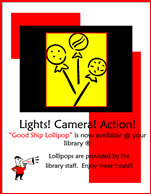
At the bottom of the Library Events page, Dr. Cherry has included her PowerPoint from a presentation she gave at ALA along with a description of how she and her staff pull this off. For those of you who are concerned about finding the time to do marketing, Dr. Cherry's project description could provide some consolation. RBC has a staff of 3 librarians and no on-campus printing facilities. To top it off, RBC has no funds for marketing, relying on their Friends of RBC Library to pay for events.
Thank you to Dr. Cherry for sharing this information and her insights!
Wednesday, April 20, 2005
Success with "dumb" marketing?
A very worthwhile post appeared today in dBusinessNews.com Los Angeles called, "The Remarkable Genius of Dumb Marketing and Why It’s So Great". There is some good discussion about "neighborhood marketing" and the importance of getting to know your customers locally. (Hm. Maybe Pepsi could learn a thing or two from libraries!). Also, some potentially helpful reads are mentioned.
Baseball cards part II
In response to those of you who were eager to get a pic of the McGoogan Library of Medicine's award-winning baseball info cards I wrote about last month, the wait is over! Teresa Hartman was kind enough to share a link to a picture of the front of the card:
http://flickr.com/photos/74939117@N00/9969182/
Teresa says that the back of the card has black text against a white background and includes the library's contact information.
Thanks, Teresa!
Update: Teresa used a company called Mint Cards as her supplier. Apparently, their rates are pretty reasonable if you're interested making cards for your library and Teresa had a good experience with them.
Tuesday, April 19, 2005
Building up a marketing resistance?
An article appearing yesterday in destinationCRM.com (CRM, by the way, stands for Customer Relationship Management), discusses the marketing burnout that many customers are feeling as they are inudated with ads from both traditional and new media. The article entitled, "Consumers Still Resist Marketing Attempts," struck a chord with me since I regularly find myself wondering if students are really reading the flyers, posters, e-mails and web pages we create to advertise our services, or if they're tuning it all out.
The article points out that it's not that customers resist all advertising, but that they would like advertising that they can control. They want marketing that is short and to the point, that they can view when it is convenient for them, and they also like to hear about products and services directly from friends and or other people they trust.
I think this has some interesting implications for libraries. Concise directed marketing, making good use of word-of-mouth advertising through building personal relationships, and resisting the tempation to bombard students with information might go a long way toward getting our messages across. Have any examples to share?
Monday, April 18, 2005
Library services by students, for students
Pat Wagner of Pattern Research, Inc. suggests an innovative way to market libraries to students by inviting them to be active players behind the scenes. By allowing students to take part in important decisions, they become stakeholders and have a personal interest in the welfare of the library. As Pat describes:
Every time a library allows a library user the ability to make a significant decision, execute a plan, run a program or in other way be in control - real partnerships - the closer they are to this idea. Small examples - the Scottsbluff Nebraska Library's teen board chooses the programs and runs them for other teens. So 17 year olds are delivering programs for 17 year olds. Attendance skyrocketed. Farmington Public Library taught young people from the tribal nations to run reading centers - in effect, the teens are running the "libraries" on the reservation.
This kind of intiative may not work at every library. Pat points out that giving students more control means that librarians will need to give up give up some of it, and that requires an organization that is flexible and willing to take risks.
Please share your experiences with giving students the reigns!
Thursday, April 14, 2005
Marketing on a budget
A friend of mine at ACRL mentioned to me that she felt a little overwhelmed by all of the ideas floating around at the conference. She works at a small library and didn't feel as though they have the staff to incorporate all of the ideas they would like. I've been thinking about this statement, which is why a recent article from the Chicago Tribune called, "Marketing needn't be complicated, costly to be effective," caught my eye. According to the article, the key is to think very carefully about what exactly you want to accomplish, which will then help you to allocate your resources accordingly. Essentially, simple things like knowing your customers and striking a rapport with them can compensate for the lack of a full-blown marketing campaign.
A previous post of mine (January 14, 2005) about READ posters describes one library's successful experiment with homegrown and inexepensive advertising.
Are there any librarians out there who have been able to make a little go a long way? Care to share?
Wednesday, April 13, 2005
FORE! Library coming through!
The James E. Walker Library at Middle Tennessee State University has "minted" a fun way to reach out to students on campus. Librarians rove around on their MintMobile handing out, well, mints of course, while talking to students about library services.
The MintMobile has been warmly received by students. According to William Black, Administrative Services Librarian at MTSU, the project began last year as librarians wanted a way to get out of the library and build a rapport with students. Black states, "We succeeded in arranging for a booth during the lunch period at the university commons and started decorating and taking the golf cart out to talk to students about the library. One of the phrases we used was "Don't Google yourself out of an 'A'."
Thanks to William Black for sharing this idea and pics!
Tuesday, April 12, 2005
FREE marketing tutorial from KnowThis.com
Ok, I admit that is says something about me that I am always emphasizing the "freeness" of the resources I mention. But, hey, free is good. And speaking of good and free, there is a 10-part tutorial from KnowThis.com called "The Principles of Marketing." Part One is entitled "About Marketing", which seems to cover the basics. The other nine parts are forthcoming and will include "Understanding Customers" and "Targeting Markets," among others. Check it out and let me know what you think!
Also, I just discovered and really like KnowThis.com, so I'll be listing it as a resource.
Putting the academic library on the community's radar
At the ACRL 12th National Conference last week, librarians from Kansas State University, Baylor University, and Gettysburg College talked about their successes in community outreach through hosting ALA Public Programs' Traveling Exhibitions in a panel session called "Academic Libraries Reap Benefits from Community Outreach." Maybe some of these programs will work for you too. Some things to keep in mind: be prepared to generate lots of children's programming, hype up the exhibits well in advance, and let community members take ownership of the events. Look at ALA's list of Current Public Programs for details. By all accounts, ALA is pretty good about supporting institutions that are awarded exhibitions and the new connections made in the community are valuable.
Monday, April 11, 2005
Steer clear of website potholes
We all know how important the Web is for communicating to patrons our libraries' hours, services, news, and resources. Our websites are almost invariably where we refer patrons when they have questions. Are we really maximizing this most important marketing tool? An article in Bytestart gives 10 pieces of advice for avoiding website marketing mistakes. While the article is directed at small businesses, there's some good food for thought for libraries too.
Friday, April 08, 2005
New Zealand innovation in current Marketing Library Services newsletter
In the current issue of Marketing Library Services (v.19 no.2), retail consultants from John Stanley Associates took a field trip to New Zealand to get a peek at what innovations librarians have come up with to attract patrons, as described in "Studying Progressive Libraries: An Adventure in New Zealand." And it sounds like New Zealanders are doing something right - according to the article, libraries there enjoy 80%+ community usage, more than triple what we see in the U.S.!
The authors outline lessons learned from their journey abroad and point out creative ideas (ever heard of wine in libraries?!).
If you are interested in learning more about retail topics, John Stanley Associates offers a free monthly e-newsletter.
Thursday, April 07, 2005
DuPage Library Teleconferences
The College of DuPage's Library Teleconferences are offering some terrific marketing resources and they're free! In one of their new series, "Library Challenges and Opportunities," speakers presented on library marketing and library as place. While these two teleconferences have already taken place, materials from both talks are available online. Of special interest, take a look at "Library Marketing: Tips and Techniques" for speakers' slides as well as online and print resources. Admittedly, I missed this one, but I did have a chance to see "Library as Place: Where People Want to Be," which was excellent. In this talk, library directors described how they have transformed their libraries into attractive destinations, and included a lot of talk about marketing. My jaw dropped as I saw images from the Southfield Michigan Public Library (it's worth your while to take a virtual tour!).
The next teleconference in this series will take place on Friday, April 29th from noon to 2pm. The subject will be "Library Hot Topics" that will delve into pressing issues.
Wednesday, April 06, 2005
Marketing to the rescue?
Can marketing sway international politics and is there a lesson here for librarians? Maybe. An article in Boston.com News by Clay Risen entitled "Re-branding America" discusses the possibilities and pitfalls of "nation-branding," defined by Risen as "what you get when you take traditional public diplomacy strategies and add marketing tools designed to change national perceptions." In the article, Risen notes the importance of "living the brand," or backing up marketing initiatives with services, or in this case policies, that reinforce the marketing piece. Consistency, it is argued here, is the key to successful marketing campaigns and so any exercise in nation-branding should include concrete policies that further the image a nation is trying to create.
This idea of "living the brand" makes me think of the UNC sticker ads from one of my previous posts. It's wonderful that the stickers have been so popular with students, but the key to that success, in my mind, is that UNC did its research and identified a chat tool that is already widely used by students (AOL Instant Messenger) and that students can reliably use the library's buddy name to get good reference service.
Have any of you made changes to your services as a direct result of your marketing plan? Please share!
Tuesday, April 05, 2005
Marketing virtual chat reference at UNC-Chapel Hill
UNC-Chapel Hill Libraries have found a fun and effective way to advertise their AOL Instant Messenger chat reference service. They have created a sticker noting the library's "buddy name" that students use to send their instant messages to librarians, shown here:
Suchi Mohanty, Reference and Instruction Librarian at the R.B. House Undergraduate Library, has provided this description of how their stickers have been received:
"UNC-CH requires all incoming undergraduates to have a laptop, and in looking around campus, we noticed that many students decorate their laptops with stickers. We thought that by designing stickers, students might be likely to put them on their laptops - reminding them about the service, but also advertising it to other students. I have seen students put the stickers on their notebooks, laptops and even water bottles. We distribute these stickers at summer orientation to new students, in library instruction sessions, and at the reference desk. Most students think they are pretty cute."
Thanks to Suchi for sharing this idea!
Update:
In response to Suchi's comment, click here to see the updated version of the sticker.
Monday, April 04, 2005
Explore the American Marketing Association's web site
If you've never taken a look at the American Marketing Association's web site, you may want to check out some of the great, FREE resources it offers. Here you can find Best Practices on topics like Internet Marketing and Marketing Strategy, articles and reports, a dictionary of marketing terms, and you can also sign up for a free newsletter.
I've now listed this as a resource under "Resource Links."


 Libraries are more than just collections of books and other materials. Libraries are dynamic forces in their communities with the power to improve lives. Modern marketing demands that librarians look beyond their traditional roles ("outside the book") to find new ways to connect with people and further their success.


